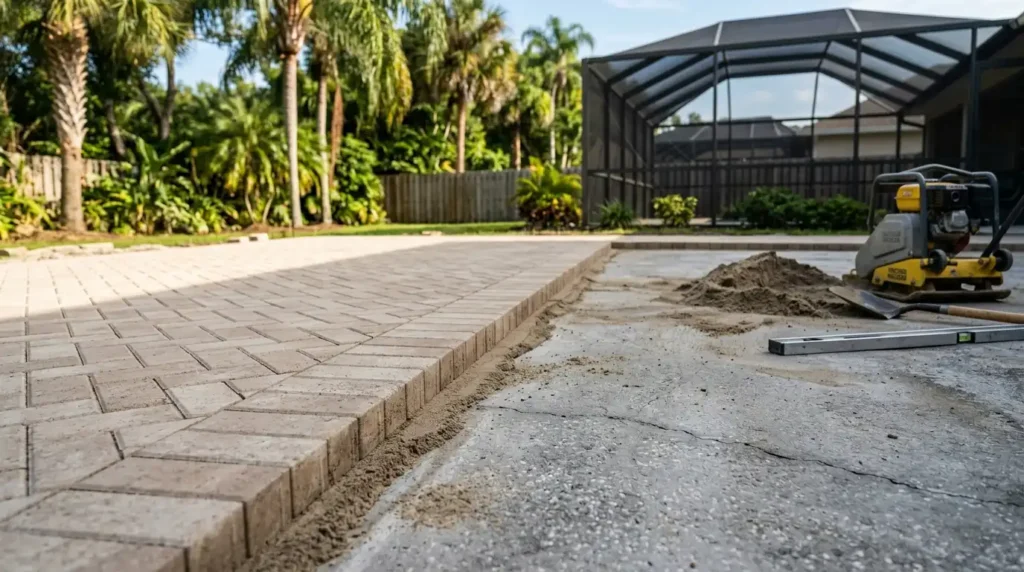
Can you put pavers over concrete? Yes, when your slab passes four checks. It must be sound and drain water. You need room for the added height. Every edge needs solid support. Pass all four and a paver overlay saves demolition and haul-off.
I’m Ron Bradley, with over 30 years in concrete and pavers here in Winter Springs. At Ron Hodges Inc, we check the existing slab before we quote any overlay.
The Short Answer: When Can You Put Pavers Over Concrete?
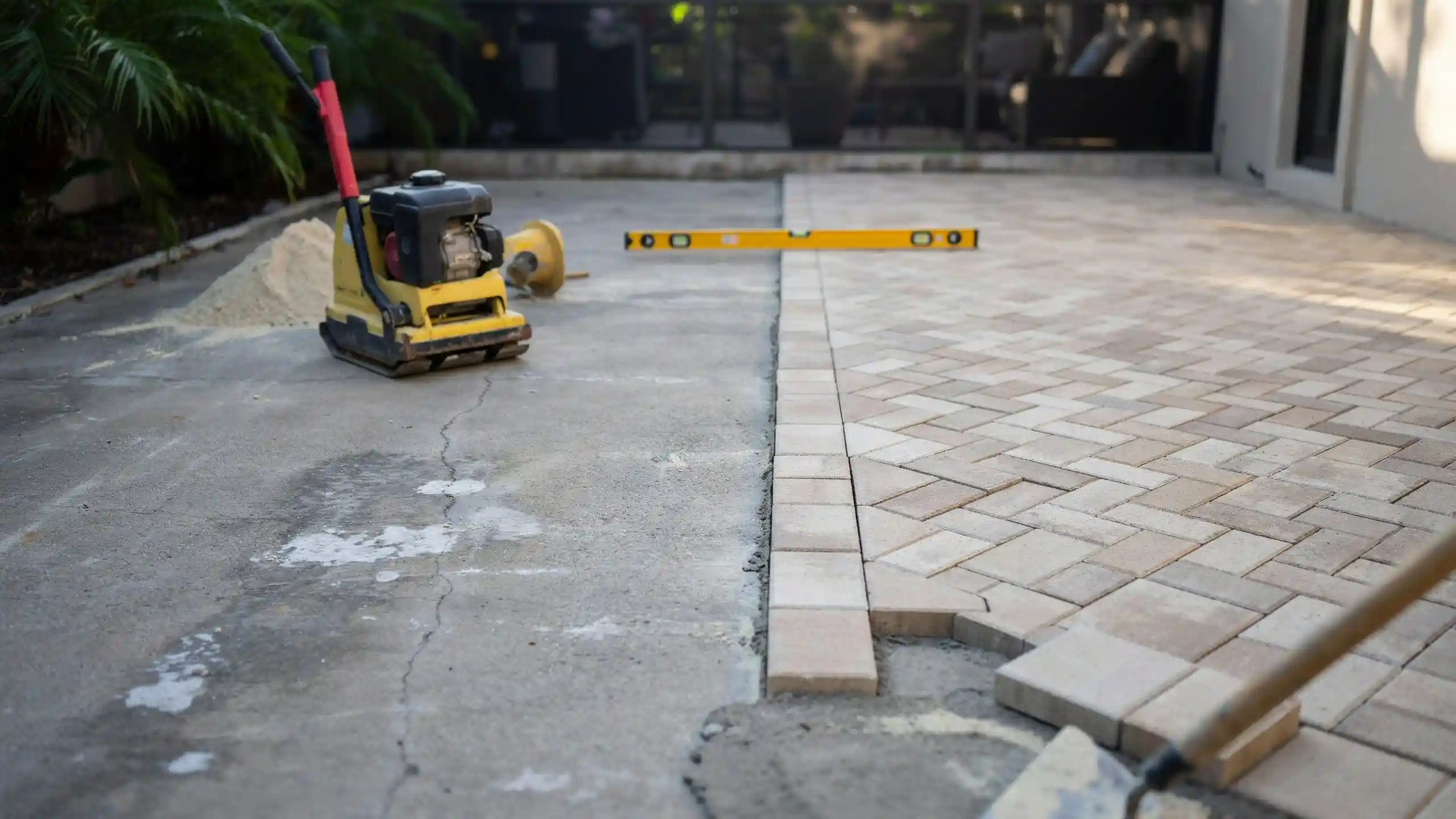
You can if the slab meets all four points.
- Structurally sound: No wide cracks, heaving, or rocking.
- Drainage: Water runs off, or you can add weep holes.
- Clearance: The new surface stays below door thresholds and works with steps.
- Edge restraint: Every open edge has a border or fastened edging.
Miss one and rebuild on compacted gravel instead.
Signs Your Concrete Is Ready (and Signs It Isn’t)
Check for a stable slab, not major cracks or sinking.
Good signs
- Only hairline cracks, with no height difference
- A drop of about 1/4 inch per foot away from the house
- Water drains within the hour
Bad signs
| Sign | What it means | What to do |
| Heaving | Soil or roots pushed it up | Rebuild |
| Settlement | The slab sank | Slabjacking, or rebuild |
| Vertical offset of 1/4 inch or more | Sections move separately | Rebuild |
| Hollow sound | Void under the slab | Remove that section |
| Rocking slab | Nothing supports it | Rebuild |
| Tree roots nearby | Roots keep lifting concrete | Cut roots, re-check |
| Flat or backward slope | Water sits on top | Add weep holes or rebuild |
Can You Put Pavers Over Cracked Concrete?
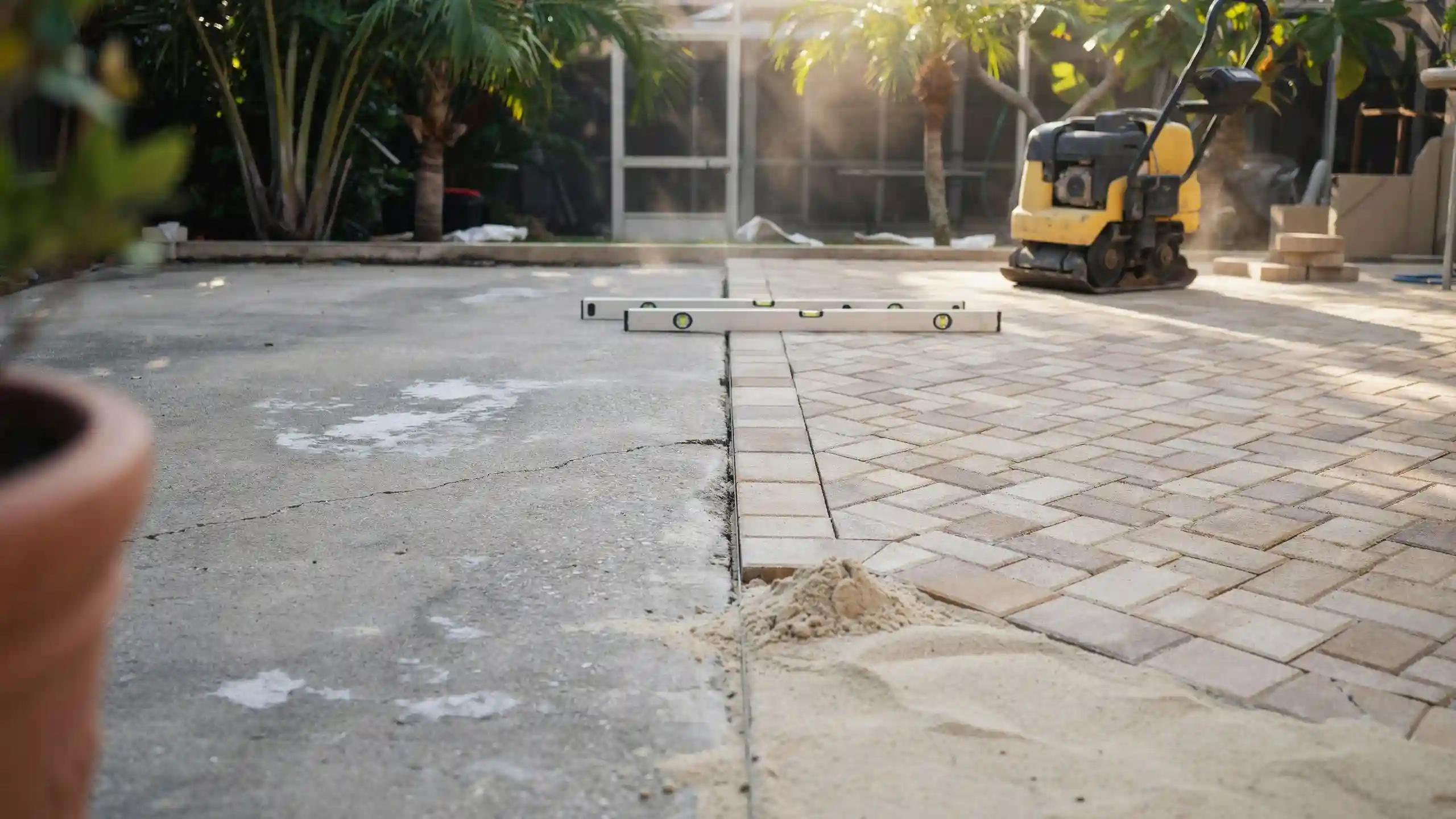
Yes, if the cracks are hairline and the slab is not moving.
Hairline vs structural cracks
Here is my rule. A crack width under 1/8 inch with no height difference is hairline. Overlay it. Between 1/8 and 1/4 inch, repair first. Over 1/4 inch is structural. So is any vertical offset of 1/4 inch or more. Rebuild those slabs.
How to repair before you lay
Fill cracks with flexible crack filler. Grind ridges flat. Lift sunken sections with slabjacking if the soil below is stable. Leave expansion joints open and fill them with flexible sealant, never hard mortar. Cover every crack and joint with geotextile. See How to Fix Cracks in Concrete Driveway.
Why sand can wash into cracks
Rain runs through the joints, then carries bedding sand into cracks. This sand migration leaves voids, and pavers sink.
Can You Put Brick Pavers Over Concrete?
Yes, with thin clay brick pavers about 1 3/8 inches thick. Wall brick isn’t made for walking. Paving brick is. Choose pavers rated to ASTM C902 with low moisture absorption, so they won’t flake after wet summers.
- Bonded border: Lay a soldier course on dots of paver adhesive.
- Sand-set field: Lay the inside bricks on thin bedding sand and sweep the joints full.
How Much Height Will Pavers Add?
A 60 mm paver is about 2 3/8 inches. An 80 mm paver is about 3 1/8 inches.
| Paver | Bedding depth | Added height |
| Thin clay, 1 3/8 in | 3/4 in mortar | About 2 1/8 in |
| 60 mm | 3/4 in sand | About 3 1/8 in |
| 60 mm | 1 in sand | About 3 3/8 in |
| 80 mm | 3/4 in sand | About 3 7/8 in |
| 80 mm | 1 in sand | About 4 1/8 in |
ICPI allows about 3/4 inch of sand over concrete, per its checklist.
- Door threshold: Keep the surface below it so rain can’t run inside.
- Stair riser: A taller patio shrinks the bottom riser.
- Pool coping: Add 3 inches and the deck can rise above the coping.
- Stucco weep screed: Codes set it at least 2 inches above paved areas, per this code summary. Under 2 inches left, the overlay won’t work there.
- Thin pavers: They add the least height.
Three Ways to Install Pavers Over Concrete
| Method | Best for | Drainage | Repair ease | Risk |
| Sand set | Patios, walkways, pool decks | Good, via weep holes | Easy | Edge creep if edges are weak |
| Adhesive or mortar set (latex-modified mortar) | Thin pavers, borders | Poor | Hard | Cracks if the slab moves |
| Bituminous set (commercial) | Plazas, vehicle areas | Good with weep holes | Moderate | Needs special crews and a bituminous binder |
For Florida patios, I recommend sand set with polymeric sand in the joints. It drains, handles small slab movement, and lets you fix one paver at a time.
How to Install Pavers Over a Concrete Patio (7 Steps)
This is how to install pavers over concrete patio slabs the way we do it. Installing pavers over concrete goes fast once the slab is ready.
- Inspect. Tap, level, and hose the slab.
- Clean. Use a degreaser and pressure washer. Grind off high spots.
- Repair. Fill cracks and lay geotextile over cracks and joints.
- Set drainage. Confirm the 1/4 inch per foot slope. Drill weep holes at low spots with a hammer drill. Cover each with geotextile and 3/4 inch stone.
- Edge and border. Snap a chalk line. Fasten edging to the slab, or bond a soldier course.
- Bed and lay. Set screed rails and spread 3/4 to 1 inch of bedding sand. Lay pavers tight. Cut edges with a wet saw.
- Compact, sweep, and seal. Run a plate compactor over the pavers. Sweep in polymeric sand, compact again, then apply sealer. See How to Seal Pavers with Sand.
Extending past the slab? Add a gravel base. Read How Do You Prepare Ground for Pavers and Can I Lay Pavers Directly on Dirt.
Why Pavers Over Concrete Fail (and How to Avoid It)
Poor drainage, weak edges, and an unstable slab can cause pavers to shift or fail.
Trapped water
Flat slabs cause ponding and algae. Add weep holes and slope.
No edge restraint
Without fastened edges, pavers spread. That is edge creep.
Rocking pavers
Uneven sand or high spots cause rocking. Grind flat and screed evenly.
Weeds in joints
Use polymeric sand and sealer. Sweep debris away.
Sand loss
Sand escapes through cracks and weep holes. Geotextile stops it. Drainage also limits efflorescence, white salt stains.
Bad height planning
Covering a weep screed or door is costly to undo. Measure first.
Which Surfaces Work? Patio, Walkway, Pool Deck, Driveway
| Surface | Works? | Notes |
| Patio | Yes | Sand set, 60 mm pavers |
| Walkway | Yes | Check door and step heights |
| Pool deck | Yes | Slip resistance, drainage, coping height |
| Driveway | Only if the slab is sound | 80 mm pavers, strong edges, extra care at the garage apron |
ICPI’s tolerance guide sets 80 mm as the minimum for driveway load.
Pavers Over Concrete in Central Florida
Can you put pavers over concrete in Central Florida? Yes. We have no freeze-thaw cycle. Other things matter more.
Summer rain tests drainage. Sandy soil washes out under slab edges. Algae grows on shaded pavers. Ants dig loose joints. Heat makes pool decks hot, so choose lighter colors.
We see these problems in Winter Springs, Oviedo, and Longwood.
Overlay or Tear Out? Cost and Lifespan Compared
On a 300 square foot patio, tearing out costs $300 to $1,800 for removal plus $2,700 to $6,000 for pavers. That is about $3,000 to $7,800. An overlay skips demolition, haul-off, and the gravel base.
| Factor | Overlay | Tear out |
| Works when | Slab passes four checks | Slab is cracked or sunk |
| Demolition, haul-off | None | $1 to $6 per sq ft |
| Compacted gravel base | None | Required |
| Labor, material per sq ft | Lower | Higher |
| Longevity | Depends on the slab | Depends on base |
When to Call a Contractor
A slab inspection takes one visit. We tap, level, and hose-test the slab.
Can you put pavers over concrete at your home? We’ll tell you straight. Ron Hodges Inc offers a free slab check in Winter Springs, Oviedo, and Longwood. See our Paver Installation in Winter Springs FL.
Contact Ron Hodges for paver and concrete service in Florida
FAQs
Do you need gravel over concrete?
No. A sound slab is your base. Use gravel only past the slab’s edge, and as a scoop of stone over weep holes so sand can’t escape through them.
Can you glue pavers to concrete?
Yes, with paver adhesive or latex-modified mortar. Glue suits borders and thin pavers. A glued field blocks drainage and cracks if the slab moves, so sand set is safer.
How thick should the sand be?
Use about 3/4 to 1 inch of bedding sand. ICPI calls for 1 inch and allows about 3/4 inch over concrete. Thicker sand compresses unevenly and leaves pavers sunk or rocking.
Will pavers shift without mortar?
Not when edges are fastened and joints hold polymeric sand. Pavers interlock and spread the load across the field. Shifting starts at weak edges, so a solid border matters most.
Will weeds grow in the joints?
They can. Seeds blow in and sprout in debris that settles in the joints. Polymeric sand, sealer, and regular sweeping keep joints tight and cut weed growth.