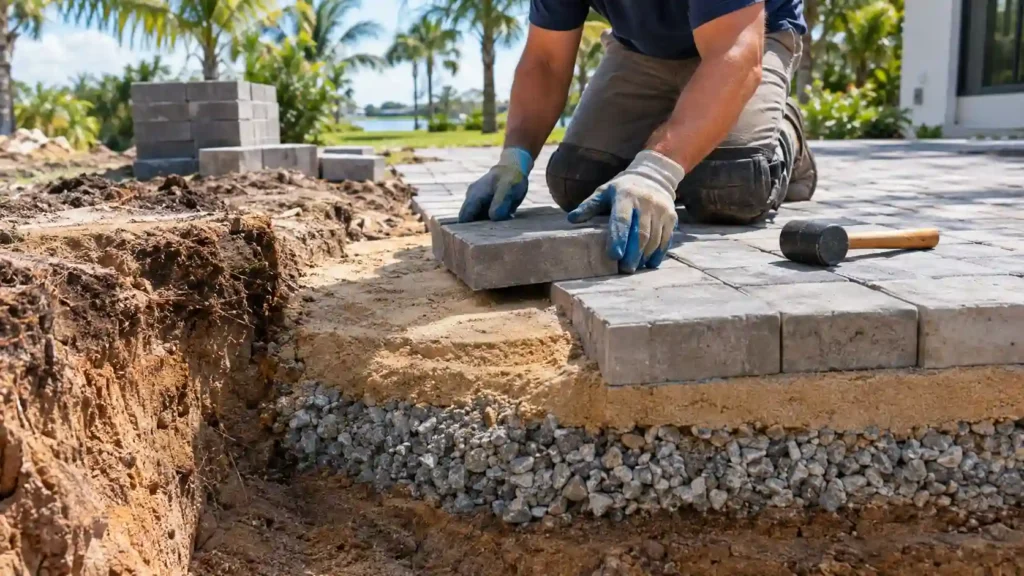
Short answer: no, not for anything you want to last. Pavers laid straight on dirt will shift, sink, and crack within a season or two. If you’re asking can i lay pavers directly on dirt because you want to skip a step, you’ll end up doing the job twice.
That said, there are a few exceptions worth knowing. Keep reading and you’ll know exactly what your project needs before you buy a single paver.
Can You Put Pavers Directly on Dirt?
Do not place pavers directly on dirt, as natural soil expansion and shrinkage will quickly cause them to shift, sink, and separate. For a flat, long-lasting installation, you must excavate the dirt and build a stable foundation using a compacted gravel base and bedding sand.
Every paver manufacturer and every experienced installer says the same thing: can you lay pavers on dirt? Technically yes, you can set them down. But “can” and “should” are two different questions here. A stable installation needs a compacted base under the pavers, not raw soil.
What Happens When Pavers Are Installed on Dirt?
Skipping the base doesn’t save you money. It just delays the cost and adds more work later.
Here’s what happens over time:
- Sinking. Dirt compresses under weight, especially foot traffic or a parked car. Pavers settle unevenly.
- Shifting. Without a firm layer to lock them in place, pavers drift out of pattern.
- Weeds. Bare soil under paver joints gives weed seeds a place to grow.
- Water pooling. Dirt doesn’t drain the way gravel does, so water sits under and around the pavers.
- Frost heave. In areas with freeze-thaw cycles, trapped moisture expands and pushes pavers out of level.
Even in Florida, where hard freezes aren’t the main concern, heavy summer rain does similar damage. Water gets trapped under the pavers, softens the soil, and the surface starts to wave.
Why a Proper Paver Base Matters
A proper paver base acts as a structural foundation, using a layer of compacted angular crushed stone and 1 inch of coarse concrete sand to evenly distribute weight and ensure water drainage. Without this solid base, pavers will inevitably fail, leading to sinking, shifting, localized ruts, and destructive frost heaves in cold climates.
To determine your digging depth, add your required stone base thickness (4–6 inches for patios/walkways or 8–12 inches for driveways/wet clay) to the 1-inch sand layer and your paver thickness. Always use sharp, locking road-base gravel rather than rounded pea gravel or fine stone dust, which retain moisture and shift easily under pressure.
If you want to understand the materials themselves before you dig in, our guide on How to Seal Pavers with Sand breaks down the types, sizes, and what makes one paver different from another.
What Goes Under Pavers?
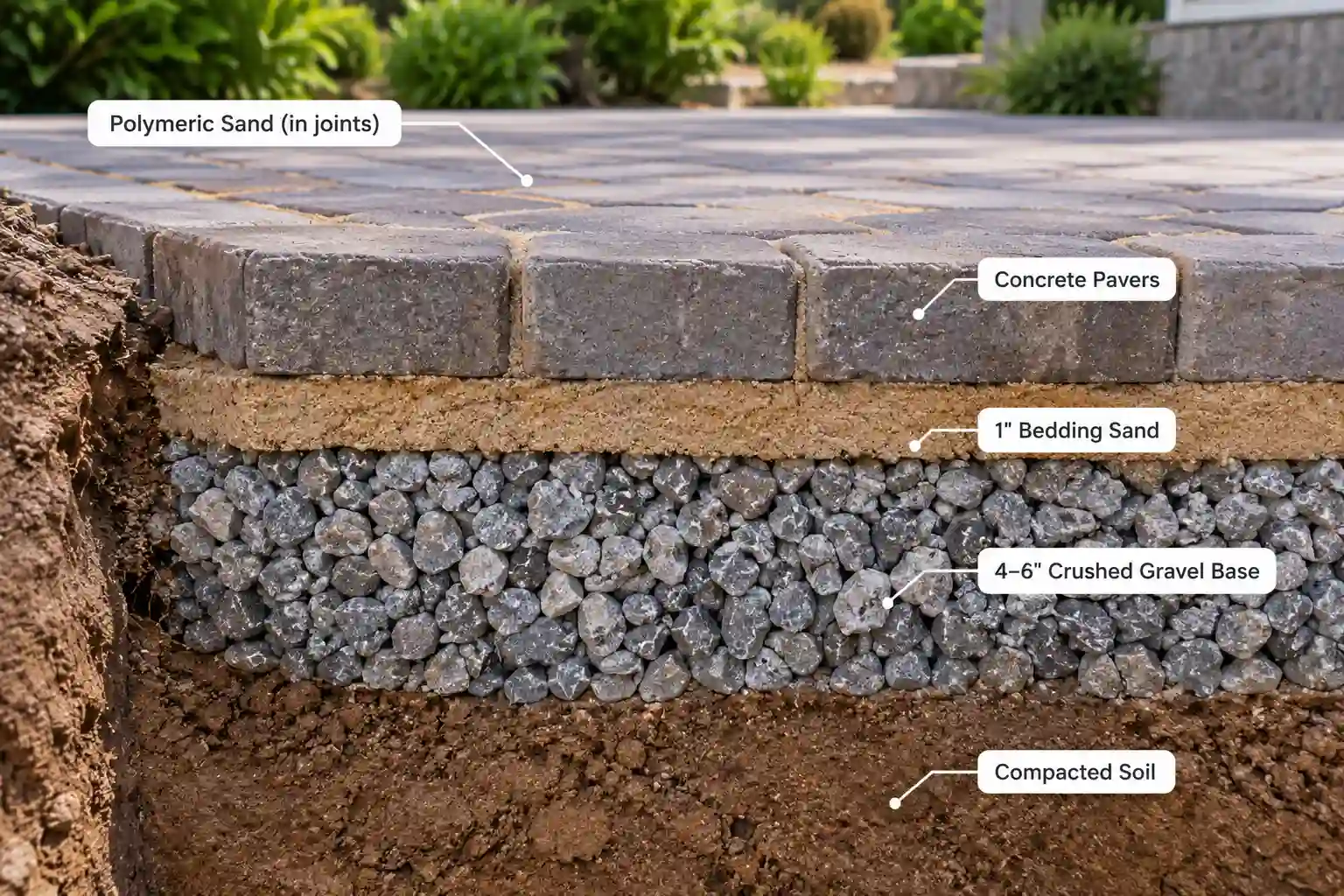
A correct paver installation has three layers, from bottom to top:
- Compacted soil subgrade. The dirt is excavated and compacted first, so it isn’t loose.
- Base layer. Crushed gravel or crushed stone, spread 4 to 6 inches deep and compacted in stages, not all at once.
- Bedding sand. A thin, screeded layer of coarse sand, about 1 inch, that the pavers sit directly on.
Some installers add a layer of landscape fabric between the soil and the gravel. This keeps the two layers from mixing over time and cuts down on weed growth.
Skipping any one of these layers, even just the sand or just the fabric, weakens the whole system. This is why can pavers be installed on dirt keeps coming up as a search question. People want a shortcut, and the honest answer is that the layers exist for a reason.
How to Prepare Dirt for a Paver Patio or Walkway
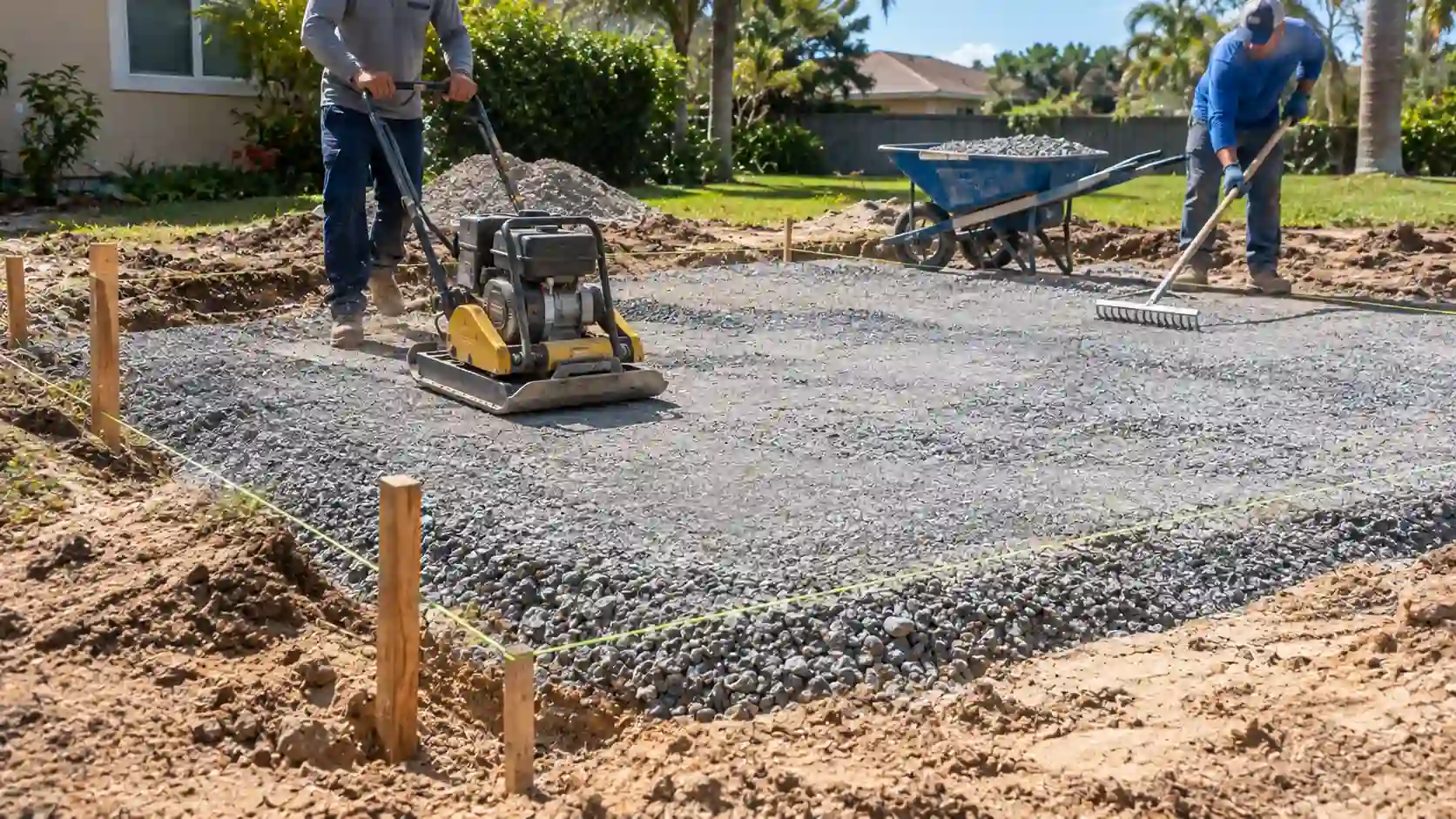
Here’s the process contractors actually follow, broken into steps you can picture:
- Mark the area with stakes and string so you know exactly where you’re digging.
- Remove grass, roots, and topsoil. Organic material breaks down over time and creates air pockets under your pavers.
- Excavate to the right depth. This depends on soil type and paver thickness, usually 7 to 9 inches total for a patio.
- Compact the exposed soil with a plate compactor before adding anything on top.
- Add and compact the gravel base in 2-inch layers, wetting slightly between passes for better density.
- Screed the sand layer flat and level using guide pipes.
- Lay the pavers in your chosen pattern, tapping each one into the sand with a rubber mallet.
- Fill the joints with polymeric sand and compact the whole surface one more time.
This is also the point where a lot of homeowners ask about sealing. Sealing isn’t required right away, but it does protect the color and lock the joint sand in place. Our full walkthrough on What Are Pavers covers when to seal and how to do it correctly once your pavers are down.
Can Pavers Be Installed Directly on Dirt for a Temporary Project?
Yes, but only for projects you’re fine replacing soon.
A few situations where skipping the base is reasonable:
- A seasonal fire pit sitting area you’ll take apart in a few months
- Stepping stones through a garden bed, spaced apart rather than tight together
- A short-term path for an event or a rental property staging
Even in these cases, you’ll get better results by laying pavers on a thin bed of sand instead of bare dirt. It’s a small extra step that cuts down on rocking and uneven spots. But for anything permanent, like a patio, walkway, or driveway, dirt alone isn’t going to hold up.
Does Florida Soil Affect Paver Installation?
Florida’s sandy soil significantly impacts paver installation, offering distinct structural advantages over clay-heavy soils while still requiring specific construction adjustments. In Central Florida communities like Winter Springs, Oviedo, and Longwood, the naturally sandy earth provides excellent drainage and predictable compaction, which eliminates the risks of standing water and the seasonal shifting or cracking common with clay.
However, because Florida’s intense rainy season moves massive volumes of water through the ground rapidly, a compacted gravel base layer is still mandatory to prevent erosion. Without this properly engineered drainage base, fast-moving subsurface water will wash away the fine sand beneath the pavers over time, causing the surface to sink, shift, and become uneven.
If you’re planning a project locally, our Paver Installation in Winter Springs FL covers how we adjust base depth and materials for Central Florida’s soil and rain patterns.
How Deep Should You Dig Before Installing Pavers?
Total excavation depth usually runs 7 to 9 inches for a patio or walkway, and deeper for a driveway that handles vehicle weight.
Here’s a rough breakdown:
| Layer | Typical Depth |
| Gravel base | 4 to 6 inches |
| Bedding sand | 1 inch |
| Paver thickness | 2 to 2.5 inches |
| Total excavation | 7 to 9.5 inches |
Sandy soil, like most of what you’ll find in Central Florida, generally needs a base on the lower end of that range, around 4 to 6 inches. Clay-heavy soil needs closer to 6 to 8 inches because it holds water and compacts less reliably.
On the cost side, real numbers help more than vague estimates. Base gravel material typically runs $8 to $25 per ton, plus delivery of $20 to $50 per ton depending on distance. In Orlando specifically, paver base gravel runs about $0.50 to $1.00 per square foot, and bedding sand adds another $0.30 to $0.60 per square foot.
A full professional paver patio installation in Central Florida, base included, typically lands between $12 and $25 per square foot. Cheaper quotes often mean a thinner base or one skipped entirely, which is where problems start a year or two later.
Common Paver Installation Mistakes to Avoid
Most paver failures trace back to one of these:
- Skipping soil compaction. Compacting only the gravel, not the exposed dirt underneath, leaves a soft layer that settles later.
- Using the wrong sand. Play sand or masonry sand isn’t the same as bedding sand. It shifts and washes out.
- Not compacting in layers. Dumping all the gravel at once and compacting it in one pass leaves weak spots.
- Ignoring slope. Pavers need a slight grade, usually about a quarter inch per foot, so water runs away from your house instead of pooling.
- Cutting the base too thin. A 2-inch base might look fine at first, but it won’t hold up to real foot traffic or vehicle weight.
Each of these mistakes is fixable during installation but expensive to fix after the fact, since fixing them usually means pulling the pavers back up.
When Should You Hire a Paver Contractor?
DIY paver projects can work for small, simple areas, especially if you’re comfortable renting a plate compactor and doing the physical digging yourself.
Hiring a contractor makes more sense when:
- The project involves a driveway or anything vehicles will drive on
- Your yard has drainage issues or standing water after rain
- You’re working with clay-heavy or unstable soil
- The area is large enough that uneven excavation would be hard to catch and fix by hand
- You want the work backed by a warranty
A contractor with local experience already knows how Central Florida soil behaves and how deep to dig for your specific site. That local knowledge is worth a lot when you’re trying to avoid a redo down the road.
Ready to get it done right the first time? Ron Hodges Inc has handled paver installation across Winter Springs, Oviedo, and Longwood for years, and we build every base to match the soil we’re working with, not a generic template. Contact us or call us at (407) 947-8843 or email ronhodgesinc@yahoo.com to get a quote on your patio, walkway, or driveway project.
FAQs
Can I lay pavers directly on dirt for a small walkway?
Not if you want it to stay level. Even a narrow walkway needs a compacted gravel base and sand layer, or it will develop dips and uneven spots within a season.
Can you put pavers directly on soil if the ground is already hard and packed?
Hard-packed soil is a better starting point, but it still shifts with rain and temperature changes. You still need a proper base for a lasting result.
How long does installing pavers on dirt without a base actually last?
It varies, but most homeowners notice sinking, gaps, or shifting within 6 months to 2 years, depending on rainfall and soil type.
Do I need to seal pavers right after installing them?
No. Most installers recommend waiting 60 to 90 days for the pavers and joint sand to settle first. Our guide on How to Seal Pavers with Sand walks through the right timing.
Is Florida’s sandy soil actually easier to work with for pavers?
In some ways, yes. It drains better than clay, but it still needs a compacted base to prevent erosion and shifting, especially during heavy summer rain.