
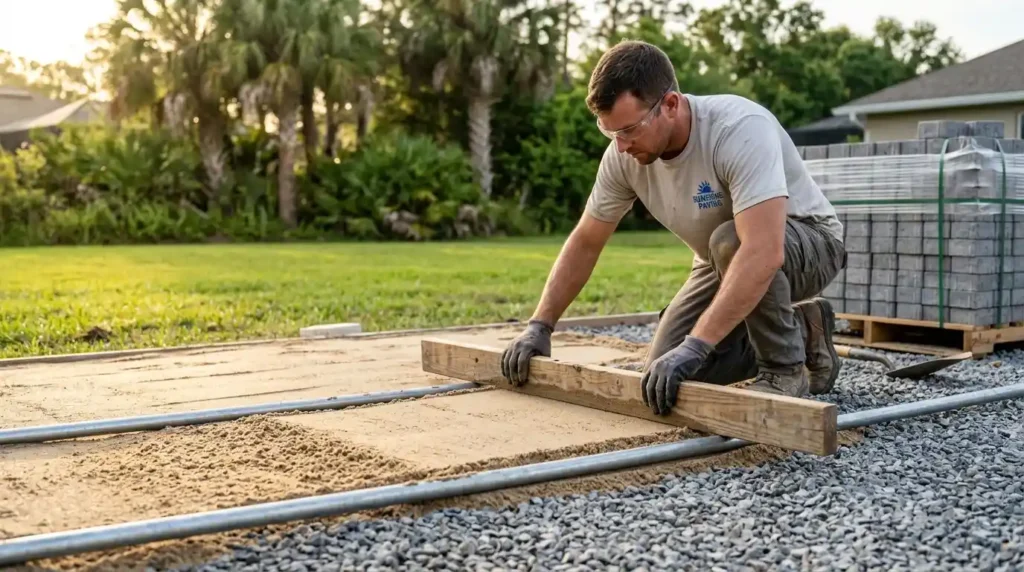
A single inch of sand decides whether your new walkway stays flat or turns wavy after a few rainy seasons. The short answer to how much sand under pavers is about 1 inch of washed concrete sand, spread loose over a compacted gravel base.
That number sounds small, but it is the step most DIY projects get wrong. At Ron Hodges Inc, we have set pavers across Winter Springs, Oviedo, and Longwood for over 30 years. This guide covers sand depth, sand type, how to figure your order, and the mistakes that cause sinking.
How Much Sand Goes Under Pavers?
Plan on a 1-inch layer of bedding sand under your pavers. That layer sits on top of 4 to 6 inches of compacted gravel for most walkways and patios.
What Is the Ideal Sand Depth for Pavers?
The Interlocking Concrete Pavement Institute (ICPI) recommends a bedding layer of 1 inch. Homeowners often ask how deep should sand be under pavers, and 1 inch is the answer for nearly every home project.
“Loose” is the key word here. You screed the sand flat and leave it uncompacted. Fix low spots in the gravel base, not with extra sand.
Does Sand Depth Depend on the Type of Paver?
No. The sand stays at about 1 inch whether you use standard 2 3/8-inch pavers or thicker ones. What changes is the gravel base, which gets deeper as the load gets heavier.
A driveway needs far more base than a garden path. Setting pavers on an old slab changes the setup too, so read Can You Put Pavers Over Concrete before you start.
What Type of Sand Should You Use Under Pavers?
The best sand to use under pavers is washed concrete sand. Its sharp, angular grains lock together and drain well, which keeps the bed stable.
Is Concrete Sand Good for Paver Bedding?
Yes. ICPI points to concrete sand that meets ASTM C33 grading. Ask your supplier for that exact label.
Washed means the clay and silt are gone. Mason sand is finer, holds more water, and settles more under traffic, so it makes a weaker bed.
Can You Use Play Sand Under Pavers?
No. Play sand has fine, rounded grains that shift and hold water. Pavers on play sand tend to tilt and sink.
Stone dust has the same problem. Polymeric sand is meant for the joints, so keep it out of the bedding layer.
How to Calculate How Much Sand You Need for Pavers
Multiply your area in square feet by 0.083, which is 1 inch written in feet. That gives you cubic feet of sand. Once you know how much sand under pavers goes into each square foot, ordering is simple math.
Calculate Bedding Sand for Your Patio or Walkway
Use these steps to answer “how much bedding sand do I need for pavers” on any size job:
- Multiply length by width to get square feet.
- Multiply that number by 0.083 for cubic feet.
- Add 10% for spills and uneven spots.
- Divide by 27 to convert cubic feet to cubic yards.
A 10 by 12 foot patio is 120 square feet. That needs 10 cubic feet, or about 11 with the extra, which is roughly 0.4 cubic yard.
| Area | Sand at 1 inch | With 10% extra | Cubic yards |
| 50 sq ft | 4.2 cu ft | 4.6 cu ft | 0.17 |
| 100 sq ft | 8.3 cu ft | 9.2 cu ft | 0.34 |
| 200 sq ft | 16.7 cu ft | 18.3 cu ft | 0.68 |
| 300 sq ft | 25 cu ft | 27.5 cu ft | 1.02 |
How Many Bags of Sand Do You Need for Pavers?
Check the bag size first. Many bags hold 0.5 cubic foot, so 100 square feet needs about 19 bags.
Past 200 square feet, bulk delivery is easier than hauling dozens of bags. Your local supplier can tell you what they carry.
What Goes Under the Sand When Installing Pavers?
A compacted gravel base goes under the sand, and compacted soil goes under the gravel. Skip either layer and the surface will not hold.
How Thick Should the Gravel Base Be?
Use 4 to 6 inches of compacted crushed stone for walkways and patios. Driveways need 8 to 12 inches.
Spread the stone in lifts of about 4 inches and compact each one. Central Florida soil is sandy, so firm compaction matters even more here.
Why Proper Base Preparation Matters for Paver Stability
Sand is a leveling layer, not a foundation. It cannot carry weight on its own.
The base spreads the load and lets water drain. Most sinking and rocking traces back to a weak base, and our summer downpours expose it fast.
How to Prepare and Level Sand Before Laying Pavers
Screed the sand to an even depth, then keep it loose. Lay pavers on it the same day.
How to Screed Bedding Sand to an Even Depth
Keep the thickness of sand layer for pavers the same from edge to edge. Here is the process:
- Check that the base is level and slopes away from your house about 1/4 inch per foot.
- Lay two 1-inch pipes on the base as guides.
- Spread sand between the pipes.
- Pull a straight 2×4 along the pipes to level the sand.
- Remove the pipes, fill the grooves, and smooth them with a trowel.
Never walk on the screeded sand. Screed only the area you can cover that day.
Should You Compact the Sand Before Laying Pavers?
No. Compact the base, not the sand. Packed sand creates hard spots that leave pavers uneven.
After you set the pavers, run a plate compactor over them. That seats them into the sand. Then sweep joint sand into the gaps.
Can You Put Too Much Sand Under Pavers?
Yes. Anything past about 1.5 inches is too much, and the extra depth causes trouble over time.
What Happens If the Sand Layer Is Too Thick?
Thick sand compresses unevenly under foot traffic and cars. Pavers sink, tilt, and form ruts. Joints open up and lines start to wave.
Too little sand is a problem too. High spots in the base show through, and pavers rock.
Signs of an Uneven or Unstable Paver Base
Watch for these warning signs:
- Dips or ruts where people walk
- Pavers that rock or tilt when stepped on
- Wavy joint lines
- Puddles that stay after rain
- Sand washing out of joints, or ant mounds along them
Regular upkeep helps, and our guide on Do Pavers Need Maintenance explains it. But sinking spots usually mean the base needs a rebuild.
Common Mistakes When Adding Sand Under Pavers
- Using play sand, stone dust, or polymeric sand as bedding
- Skipping the gravel base to save time
- Compacting the sand before the pavers go down
- Using extra sand to hide big dips in the base
- Walking on the screeded bed
- Leaving screeded sand out overnight where rain can reach it
- Mixing up bedding sand and joint sand
When Should You Hire a Professional Paver Installer?
Hire a pro for driveways, large patios, slopes near a pool or house, and any spot with drainage trouble. A crew brings a plate compactor and knows how Central Florida soil and rain behave.
Our team at Ron Hodges Inc handles Paver installation from base prep to the final sweep of joint sand. You get a flat surface that stays that way.
Final Thoughts
Use 1 inch of loose, washed concrete sand over 4 to 6 inches of compacted gravel. Screed it evenly, leave it uncompacted, and skip play sand. Knowing how much sand under pavers you need is only half the job, because the base matters just as much.
Ron Hodges Inc builds paver walkways, patios, and driveways across Winter Springs and nearby Central Florida. Contact us today through your project and get an estimate.
FAQs
Is 1 inch of sand enough under pavers?
Yes. One inch of loose sand is the standard for patios, walkways, and driveways when the base is solid.
Can you lay pavers directly on sand?
No. Sand cannot carry loads alone. It needs at least 4 to 6 inches of compacted gravel below it.
Do you need to replace bedding sand when replacing pavers?
Not always. Reuse clean, dry sand and top off low spots. Replace it if it is muddy or full of roots.
Is bedding sand the same as joint sand?
No. Bedding sand is the coarse layer under the pavers. Joint sand is finer and gets swept between them.
How much sand do you need for a 10 by 10 patio?
You need about 9 cubic feet, including extra. That is roughly 19 half-cubic-foot bags.