How do you prepare ground for pavers? To prepare the ground for pavers, excavate the soil, slope it 1/4 inch per foot for drainage, compact the subgrade, add a crushed aggregate base in layers, screed a 1-inch sand bed, and lay the pavers. Skip standard gravel for patios and walkways dig down 7 to 9 inches to fit a 4 to 6 inch compacted base, while driveways require a deeper 10 to 14 inch excavation to handle vehicle weight.
In Central Florida, use crushed concrete fines for your base instead of standard gravel because it locks tightly together. Because native Florida sugar sand shifts easily, thoroughly saturate the subgrade with water right before compacting it, and lay down a woven geotextile fabric to stop your base from sinking into the sand.
What Goes Under Pavers?
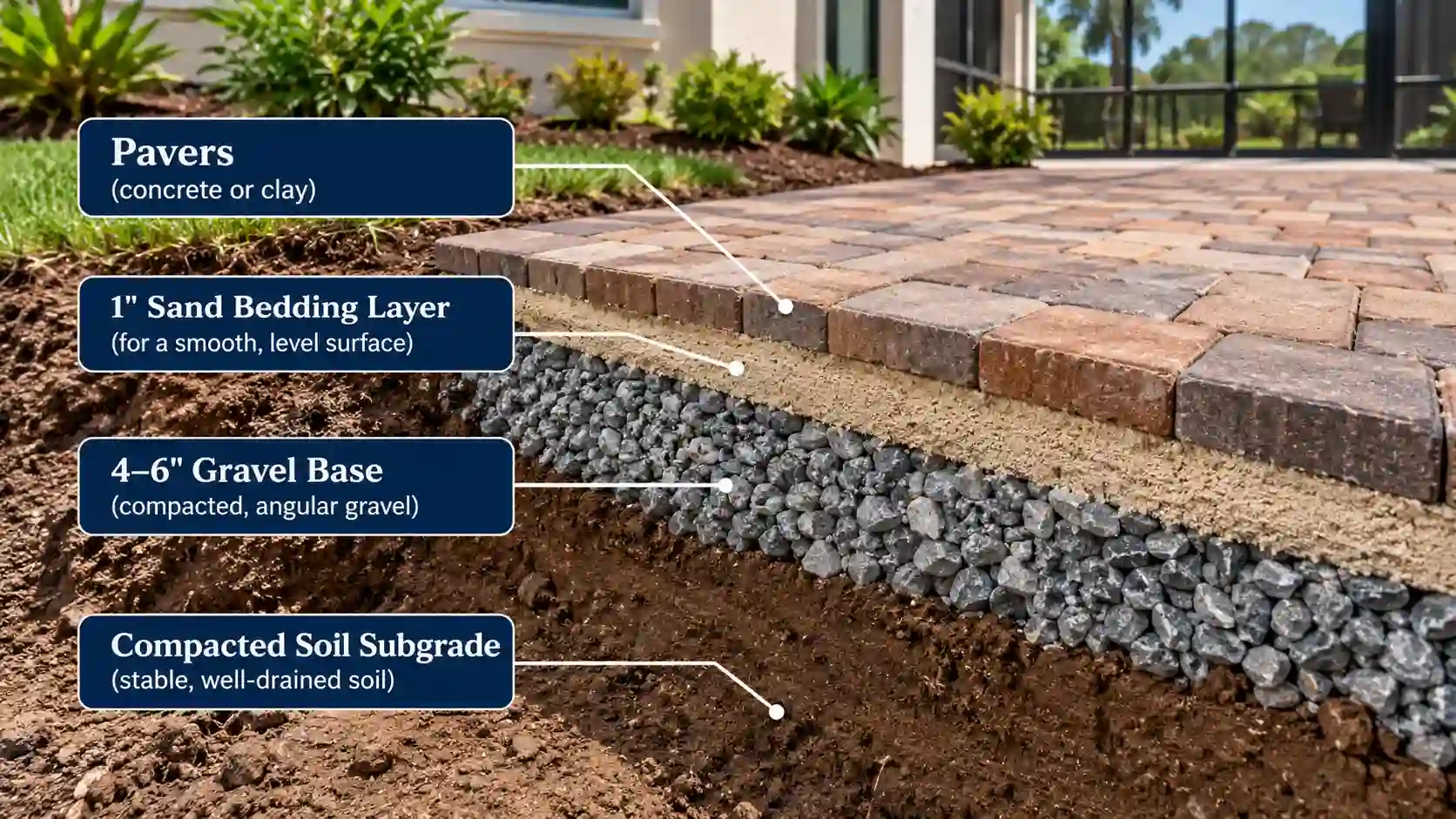
A paver patio sits on four layers: compacted soil, a gravel base, bedding sand, and the pavers. Knowing what to put under pavers keeps you from skipping the layer that fails first.
- Compacted soil (subgrade). This is the native ground. It must be firm and flat before anything goes on top.
- Aggregate or paver base. This is crushed stone that carries the weight and drains water. The Interlocking Concrete Pavement Institute (ICPI) sets a minimum compacted base of 4 inches for patios and walkways, and 6 inches for residential driveways, on well-drained soil.
- Bedding sand. This is a thin layer of coarse sand that levels the surface. ICPI calls for about 1 inch, and no more than 1.5 inches.
- Pavers. Patios and walkways usually use 2 3/8 inch pavers. Driveways need 3 1/8 inch pavers.
Two helpers frame these layers. Edge restraints hold the pavers in place from the sides. Geotextile fabric is a good choice over clay, silt, or soil that stays wet for much of the year.
What you need before you start:
- White marking paint, stakes, and string
- Shovel, wheelbarrow, and a hand tamper
- Plate compactor (rent one)
- 3/4 inch crushed stone
- Coarse concrete sand
- Two 1-inch pipes and a straight board for screeding
- Level, edge restraints, and geotextile fabric if your soil is soft
How to Prepare Ground for Pavers
Follow five steps, in order. Each one sets up the next.
1. Mark the Area and Set the Grade
Call 811 first. Florida asks you to notify Sunshine 811 at least two full business days before you dig. The marks stay valid for 30 calendar days. The call is free, and it applies to homeowners too.
Next, lay out the shape with white paint. Extend the paint about 6 inches past each side to leave room for the edge restraint.
Now set the finished height. Drive stakes at the corners and run a string line at the top of the paver surface. Keep that line below your door threshold and away from siding.
Then build in the drainage slope. Aim for a drop of 1/8 to 1/4 inch per foot. That is about 1 to 2 percent. On a 12-foot patio, the far edge sits 1.5 to 3 inches lower than the house side. Build that slope into the gravel base, not the sand.
2. Remove Grass and Excavate
Strip the sod and all the organic soil. Roots rot over time and leave gaps. Those gaps turn into dips in your patio.
How deep to dig for pavers depends on your base. The simple formula is base + 1 inch of sand + paver thickness. The next section has the numbers.
Dig a few inches past your paint lines. The base should stick out past the pavers, so the edge has support. Haul the extra soil away, or save it for grading elsewhere.
- Patio: a medium base, so a medium dig.
- Walkway: the same as a patio, since it only carries foot traffic.
- Driveway: the deepest dig. Cars and trucks push much harder on the ground.
3. Compact the Soil
Firm ground is the first job of any paver base. Pull out roots, rocks, and trash. Fill any soft spots with crushed stone, not loose dirt, and pack it in layers.
Then run a plate compactor over the whole area. Make slow, overlapping passes in both directions. ICPI recommends compacting the soil to at least 98 percent standard Proctor density for patios and residential driveways. You can’t measure that at home, but you can watch the ground. If the machine leaves ruts or your boot sinks in, keep working.
A rental runs about $60 to $150 per day. Hand tamping does not get the job done on anything bigger than a small pad.
4. Install and Compact the Paver Base
Use crushed stone with sharp edges, like 3/4 inch angular gravel. The edges lock together as you compact. Pea gravel never compacts, so skip it.
So, how thick should a paver base be? Use 4 to 6 inches for patios and walkways, and 6 to 10 inches for driveways. Go thicker if your soil is soft, wet, or full of clay.
Add the stone in layers of 2 to 4 inches. Compact each layer before adding the next. Wet the stone lightly to help it settle.
Check the surface with a string and a straight board. ICPI allows about 3/8 inch of variation over 10 feet. Then set your edge restraints on the compacted base, not on the sand.
5. Add and Screed Bedding Sand
Spread 1 inch of coarse concrete sand. Do not use fine play sand. It holds water and shifts.
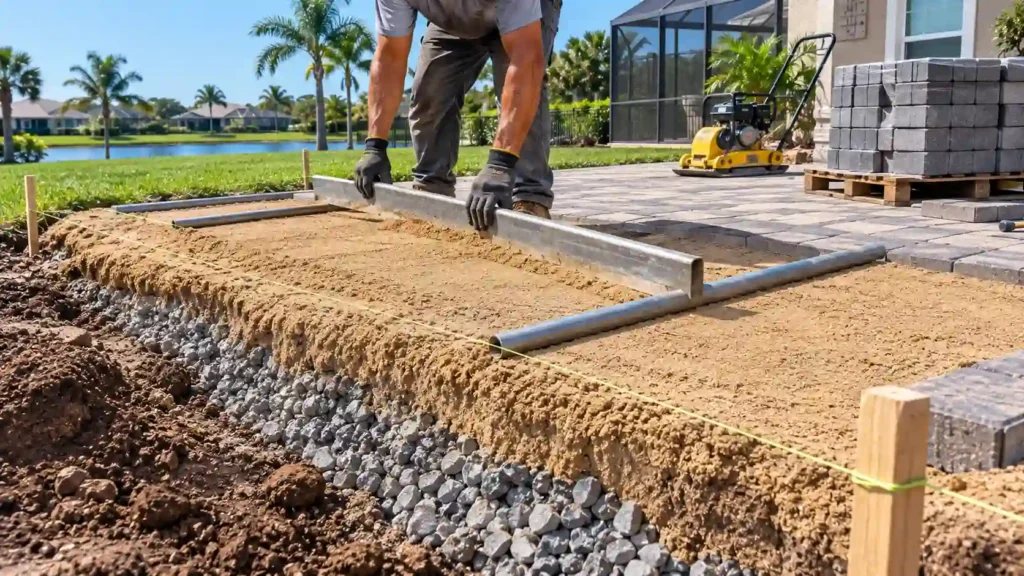
Set the two 1-inch pipes on the base as guides. Pull a straight board across them to smooth the sand. Pull the pipes out and fill the gaps with sand. Then trowel them flat.
Keep the bed level, and do not step on it. Do not compact the sand before you lay pavers either. The pavers press into it later. Sand thicker than 1.5 inches compresses unevenly and makes pavers rock.
After the pavers go down, joint sand locks them together. Our guide on How to Seal Pavers with Sand covers that finish.
How Deep Should You Dig for Pavers?
Use one formula: base thickness + 1 inch of sand + paver thickness = dig depth.
| Use | Base | Sand | Paver (typical) | Dig depth |
| Patio or walkway | 4 to 6″ | 1″ | about 2.4″ | about 7 to 9″ |
| Driveway | 6 to 10″ | 1″ | about 3.1″ | about 10 to 14″ |
You will see different numbers on other sites. The math is the same everywhere. Only the base thickness changes. One contractor in a freeze-thaw climate builds 6 to 8 inch bases for patios and 12 to 14 inches for driveways. Florida has no frost heave, so soil type and traffic decide your base.
Here is a worked example. Take a 12 by 12 foot patio (144 square feet) with a 5 inch base.
- Dig depth: 5 + 1 + 2.4 = 8.4 inches. That is about 3.7 cubic yards of soil to haul off.
- Crushed stone: 144 × 5 ÷ 324 = 2.2 cubic yards. Add 20 percent because the stone packs down under the compactor. That is about 2.7 cubic yards, or roughly 3.7 tons.
- Bedding sand: 144 × 1 ÷ 324 = 0.44 cubic yard.
Do You Need Gravel Under Pavers?
Yes. A compacted gravel base is what keeps pavers flat for years.
Gravel spreads weight across a wide area. It also drains water away and stops soil from working up into the joints. Dirt does none of that. Pavers set straight on soil sink where you walk and roll where you park. Weeds and ants move in through the gaps.
Pavers on dirt only work for a short-term path or a few stepping stones. For a permanent patio, walkway, or driveway, skip the shortcut. We break this down in Can I Lay Pavers Directly on Dirt.
The base is also cheap insurance. A driveway base adds only about $1 to $2 per square foot in material. A failed base means tearing it all up and starting over.
What Does Ground Prep Cost?
These are published national ranges from 2025 and 2026 guides. Your final price depends on your soil, access, and size.
| Item | Typical cost |
| Crushed stone base | $30 to $65 per ton |
| Bedding sand | $25 to $50 per ton |
| Geotextile fabric | $0.15 to $0.35 per sq ft |
| Edge restraints | $1 to $2 per linear foot |
| Plate compactor rental | $60 to $150 per day |
| Delivery | $75 to $200 per load |
| Pavers, fully installed | $8 to $25 per sq ft |
For a Florida example, one 2026 guide priced base work for a 500 square foot patio with a 4 inch base at about $2,680, including materials, labor, and delivery. Check that any quote lists the base as its own line. A quote with no base line item likely skips the base.
Common Paver Ground Preparation Mistakes
Most failed patios trace back to one of these six.
- Poor drainage or slope. Flat pavers hold water near your house. Give every project a slope away from the foundation.
- Not digging deep enough. A shallow dig forces you to cut the base short. The pavers then sit too high or too weak.
- Uncompacted soil. Loose soil settles under the base, and the surface follows it down.
- Wrong base thickness. A 2 inch base on a driveway won’t last a season. Match the base to the load.
- Too much sand. Sand is a leveling layer, not a base. Keep it at 1 inch.
- Skipping edge restraints. Without them, pavers creep outward and the joints open up.
Preparing Ground for Pavers in Central Florida
Central Florida changes the job in a few ways. Rain is the big one.
So how do you prepare ground for pavers when the yard soaks up so much water? Orlando averages about 51 inches of rain a year, with August the wettest month at around 8 inches. The rainy season runs May through October. Plan digging and compacting for drier weeks when you can.
The soil here is mostly sand. It holds less weight once it is soaked, and the water table rises in wet months. Wet sand also shifts under a plate compactor. Let the ground drain for a day or two after a storm.
Watch drainage closely. Check where your downspouts empty and where water pools. Grade the paved area away from the house, and never toward a neighbor’s yard. In low spots near a pond or retention area, add geotextile fabric under the base and go thicker.
Every lot is different. A flat backyard, a pool deck, and a sloped front walk each need their own grading plan. Walk the site after a hard rain and see where the water goes.
When to Hire a Paver Contractor
Small, flat walkways are fair DIY jobs. Some jobs are not.
Call a pro for driveways, pool decks, and sloped yards. Call one when the soil is soft or wet, or when you don’t have a plate compactor. Big patios also take a lot of digging and hauling. One cost guide says not to DIY a driveway, where the base runs 6 to 8 inches and needs heavier compaction.
Ask any contractor four things: the base depth in writing, how they compact, what edge restraint they use, and how they handle drainage. Good answers are short and clear.
Ron Hodges Inc builds paver patios, walkways, and driveways across Winter Springs, Oviedo, and Longwood. See how we work on our Paver Installation in Winter Springs FL. We also handle paver cleaning and sand and seal once your pavers are down.
FAQs
How deep should you dig for pavers?
Dig about 7 to 9 inches for a patio or walkway, and about 10 to 14 inches for a driveway. Add your base thickness, 1 inch of sand, and the paver thickness. That sum is your dig depth.
Can you lay pavers directly on dirt?
Not for anything permanent. Soil shifts, holds water, and lets weeds grow through. Pavers on dirt sink and wobble within a season or two. A compacted gravel base fixes all three problems.
How thick should a paver base be?
Use 4 to 6 inches for patios and walkways. Use 6 to 10 inches for driveways. ICPI sets minimums of 4 and 6 inches. Go thicker over soft, wet, or clay soil.
What type of sand goes under pavers?
Use coarse concrete sand, spread about 1 inch thick. Fine play sand holds water and shifts. Keep the layer level and never go over 1.5 inches.
Do pavers need gravel underneath?
Yes. Gravel carries the weight, drains water, and keeps the surface flat. It is the most important layer under a paver.
How do you level ground for pavers?
Compact the soil first. Then build the slope into a compacted gravel base and check it with a string line. Screed 1 inch of sand over pipes to finish. Level the base, not the sand, and keep about 1/8 to 1/4 inch of drop per foot.