What are three types of concrete? Precast, reinforced, and plain concrete are the three primary varieties. For straightforward jobs like driveways, plain concrete costs $5 to $10 per square foot and doesn’t include any steel. For structural component like retaining walls, reinforced concrete, which costs $7 to $15 per square foot, embed steel rebar for high tensile strength. Steps, blocks, and wall panels typically cost between $20 and $30 per square foot. Precast concrete is produced in factory and delivered ready to use.
As an alternative, concrete is divided into three categories based on density: heavyweight for radiation shielding, lightweight for lower structural stresses, and normal-weight for conventional pavement.
What Are the 3 Main Types of Concrete?
So, what are the 3 types of concrete? Here is the short list.
- Plain (normal-strength) concrete: cement, sand, gravel, and water with no steel. Used for sidewalks, small slabs, and footings.
- Reinforced concrete: the same mix with steel reinforcement added, like rebar, wire mesh, or fibers. Used for driveways, foundations, and structural work.
- Precast concrete: factory-cast in molds, cured, then trucked in and set in place. Used for steps, blocks, pavers, and wall panels.
Every other type you will hear about is a twist on one of these three. Let’s look at each one.
What Is Concrete Made Of?
Concrete is a composite material made of Portland cement, sand (fine aggregate), gravel (coarse aggregate), and water. When mixed, a chemical reaction called hydration occurs between the water and cement, creating a binding paste that glues the sand and gravel together into a durable, rock-like structure.
A standard concrete recipe follows a 1:2:4 ratio, meaning one part cement, two parts sand, and four parts gravel. While often used interchangeably, cement is not the final product it is simply the key binding ingredient within the larger concrete mixture.
Read our post on Is Concrete the Same as Cement.
Plain (Normal-Strength) Concrete
Plain concrete is the basic mix with no steel inside. You will also see it called normal-strength or ordinary concrete. Those names describe the same thing.
Strength comes in two kinds. Compressive strength is how well concrete resists being squeezed. Tensile strength is how well it resists being pulled or bent. Concrete is great at the first and weak at the second.
We measure compressive strength in PSI, or pounds per square inch. Sidewalks, patios, and steps can often get by with about 2,500 PSI, while driveways and garage slabs usually call for 3,000 to 4,000 PSI.
Plain concrete works well for sidewalks, small slabs, and footings. Those jobs mostly push weight straight down.
The limit is cracking. A little settling or shrinking pulls the slab apart, and plain concrete has nothing to hold it together. Penn State researchers note that concrete has low tensile strength and can crack at random without joints. That is why crews cut control joints into the slab. A common rule is to space them 8 to 12 feet apart on a 4-inch slab.
Reinforced Concrete
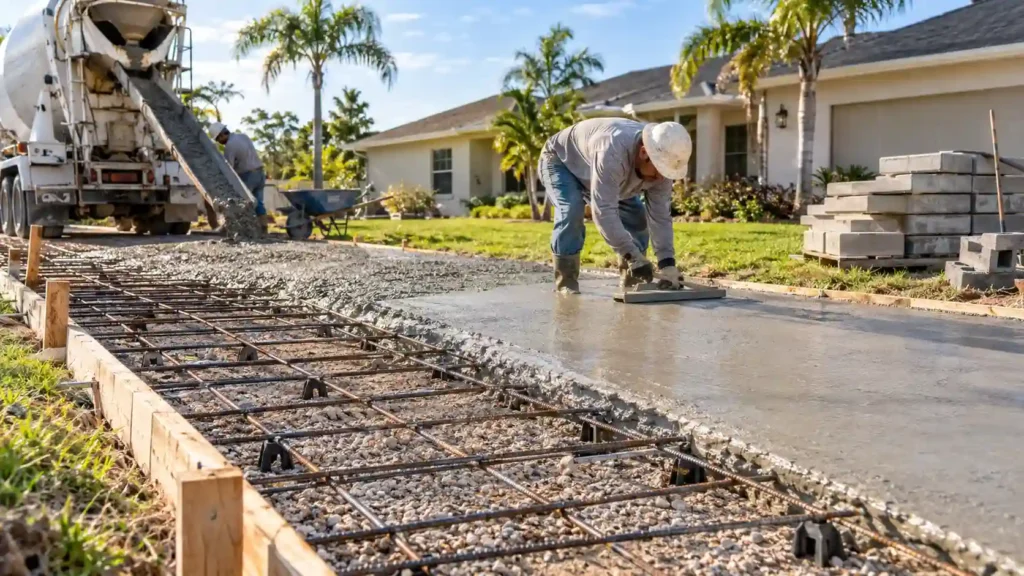
Reinforced concrete is plain concrete with steel added. The concrete handles the squeezing. The steel handles the pulling. Together they hold up to much more.
There are three common forms of steel reinforcement:
- Rebar: steel bars tied into a grid. Best for thick slabs and heavy driveway loads.
- Welded wire mesh: a thin steel grid. Common in 4-inch slabs to hold small cracks tight.
- Steel fibers: short strands mixed right into the concrete. They help control small shrinkage cracks but do not replace rebar under heavy loads.
Here is what many homeowners miss. Steel does not stop cracks. It keeps them tight so the slab stays in one piece. It also has to sit near the middle of the slab. Mesh that lies flat on the ground does almost nothing.
You need reinforced concrete for driveways that carry trucks or RVs, garage slabs, and foundations. It is also the standard for structural work like beams and retaining walls.
Precast Concrete
Precast concrete is poured into molds at a plant, not at your house. It cures there under steady conditions. Then a truck brings the finished piece, and a crew sets it in place.
Factory work means tight quality control. The mix, the steel, and the curing are all checked before the piece leaves. Precast also saves time on site. You do not wait for a slab to gain strength.
Common precast pieces include:
- Concrete blocks and pavers
- Steps and stair units
- Curbs and septic tanks
- Precast panels for walls
The tradeoffs are size and access. Big pieces need a crane and room to move. Seams between pieces also need care.
Prestressed concrete is the stronger cousin of precast. Steel tendons are pulled tight before the concrete is poured. When the concrete hardens, it stays squeezed, so it resists bending much better. You see it in bridges and long floor beams.
The Three Types Side by Side
| Plain | Reinforced | Precast | |
| Strength | Strong in compression, weak in tension | Strong in both | Strong, checked at the plant |
| Crack resistance | Low, needs control joints | High, steel holds cracks tight | High, made under controlled conditions |
| Best use | Sidewalks, small slabs, footings | Driveways, garage slabs, foundations | Steps, blocks, pavers, wall panels |
| Install speed | Poured on site, cures in days | Similar, plus time to set steel | Fastest on site, sets in place |
| Typical home use | Walkways, patios | Driveways, garage floors | Steps, retaining wall blocks |
| Cost level | Lowest | Medium | Varies by piece |
What Do These Types of Concrete Cost?
These are national ranges, not quotes. Prices change by area, so use them to get your bearings.
- Most homeowners pay $6 to $16 per square foot for a new concrete driveway, or $1,885 to $6,475 total.
- One HomeAdvisor guide lists plain concrete at $6 to $8 per square foot and stamped at $12 to $18. It puts the concrete itself at $120 to $210 per cubic yard.
- Wire mesh material runs about $1.00 to $1.50 per square foot, and rebar costs $2 to $3 per square foot installed.
Here is our own math using those figures. Take a 12 by 20 foot driveway. That is 240 square feet. At 4 inches thick, it needs about 3 cubic yards. The concrete alone costs roughly $360 to $620. Mesh adds about $240 to $360, and rebar adds about $480 to $720. Base prep, forms, labor, and finishing make up the rest.
Steel is a small part of the bill. A cracked, sunken driveway costs far more to fix.
Other Types of Concrete You’ll Hear About
The other types of concrete are the following.
Other Ways to Sort Concrete into Three
Builders also sort concrete by how it is placed. Cast-in-place is poured where it stays. Precast is made elsewhere and delivered. Prestressed has steel tendons pulled tight first.
Some sites use “three types” to mean the ingredients: cement, aggregate, and water. Those are the parts of concrete, not types of concrete. If you searched what are three types of concrete and got that answer, now you know why.
Common Specialty Types
Here are the types of concrete and their uses at a glance.
| Type | What it is | Where it’s used |
| Stamped | Patterns pressed in while wet to look like stone or brick | Patios, pool decks, driveways |
| Decorative/colored | Dye or stain added for color | Entries, patios, walkways |
| Pervious | Little sand, so water drains through | Parking areas, light-traffic paths |
| High-strength | Tested at 6,000 PSI or more | High-rises, bridges |
| Air-entrained | Tiny air bubbles that handle freezing | Cold states, rarely needed in Central Florida |
| Fiber-reinforced | Fibers mixed in to limit small cracks | Slabs, garage floors |
| Ready-mix | Mixed at a plant, delivered by truck | Nearly all home slabs |
Ready-mix is how most concrete arrives. It is not really a separate type. It is the delivery method for the types above.
Which Type of Concrete Fits Your Project?
People who ask what are three types of concrete usually want a quick answer, then help picking one. Here is the match-up for common home jobs.
- Driveway: Reinforced, 3,000 to 4,000 PSI. Pour 4 inches thick, or 5 to 6 for heavy trucks. Our post on how thick a concrete driveway should be covers the details. Our concrete driveways service shows what we build.
- Patio: Plain or reinforced, about 4 inches thick. Stamped or colored if you want a stone look. Talk to a Concrete Patio Installer in Winter Springs FL about finish options.
- Walkway: Plain concrete at 2,500 PSI or more works well. See our Concrete Walkways in Winter Springs FL.
- Garage slab: Reinforced, 3,000 to 4,000 PSI. Go thicker if you park heavy gear or a lift inside.
- Pool deck: Plain or reinforced with a broom finish for grip. Stamped works if it has a non-slip texture.
- Footings: Follow local code. Most call for reinforced concrete.
The load matters as much as the mix. A slab that carries a pickup every day needs more than a slab people just walk on.
Concrete in Central Florida
Central Florida is easier on concrete than cold states, but it has its own problems. Here is what matters most, based on Ron Bradley’s 30+ years of pouring slabs.
Sandy soil. Sand drains fast but shifts under weight. A compacted base of crushed stone or gravel keeps the slab from settling. Most cracks we see trace back to a weak base, not the mix.
Heavy rain and drainage. Summer storms dump a lot of water fast. Slope every slab away from the house so water runs off instead of pooling.
Curing in heat. Florida heat pulls water out of fresh concrete quickly. That causes surface cracks. Crews pour early, keep the slab damp, or use a curing compound. Wondering about timing?
Control joints. Cut them on time and at the right spacing. They guide cracks to clean lines.
No freeze-thaw. Cold states use air-entrained mixes to survive freezing. ACI 318 guidance points to 4,500 PSI air-entrained mixes for driveways exposed to freezing and de-icing salts. In Florida, 3,000 PSI is the common practice for residential driveways.
Slabs in Winter Springs, Oviedo, and Longwood all face the same sand, rain, and heat.
When to Call a Concrete Contractor
Small pours are fine to DIY. Contact a concrete contractor when the mix or steel layout matters. That includes heavy driveways, garage slabs, pool decks, sloped lots, and anything tied into an existing slab.
A pro handles site prep, orders the right PSI, sets the steel at the right height, and cuts joints on time. They also know which jobs need permits in your city, so you skip fines and delays.
Ron Hodges Inc pours driveways, patios, and walkways for homes and businesses in Winter Springs, Oviedo, and Longwood, FL. Still asking what are three types of concrete and which one your slab needs? Call us at (407) 947-8843 or send a message. We will look at your site, explain your options in plain words, and give you a clear quote.
FAQs
What are the 3 types of concrete?
The three main types are plain, reinforced, and precast concrete. Plain has no steel. Reinforced has rebar, mesh, or fibers inside. Precast is cast in a factory and set on site. Most home slabs are plain or reinforced.
What is the difference between plain and reinforced concrete?
Plain concrete has no steel, so it resists squeezing but cracks when pulled or bent. Reinforced concrete has rebar, wire mesh, or fibers that hold cracks tight and share the load. Driveways and foundations need reinforced concrete. Sidewalks often do fine without it.
What type of concrete is used for driveways?
Reinforced ready-mix concrete at 3,000 to 4,000 PSI works for most driveways. Florida common practice is 3,000 PSI. Pour it 4 inches thick, or 5 to 6 inches for heavy trucks and RVs, over a compacted base.
Is normal-strength concrete the same as plain concrete?
Yes. Both use the same basic mix of cement, sand, gravel, and water, and neither has steel. Some sites list them as two types, but only the name differs. The real split is concrete with steel and concrete without it.
How many types of concrete are there?
There is no fixed number. Some guides list 16 or 26 types of concrete. Most fall under the three main types plus specialty mixes like stamped, pervious, and high-strength concrete. For a home project, you only need to know a handful.
What PSI concrete do I need for a driveway or patio?
Patios and walkways need about 2,500 to 3,000 PSI. Driveways and garage slabs need 3,000 to 4,000 PSI. Check local code, and follow ACI guidance if your area sees freezing. Tell your ready-mix supplier the PSI when you order.