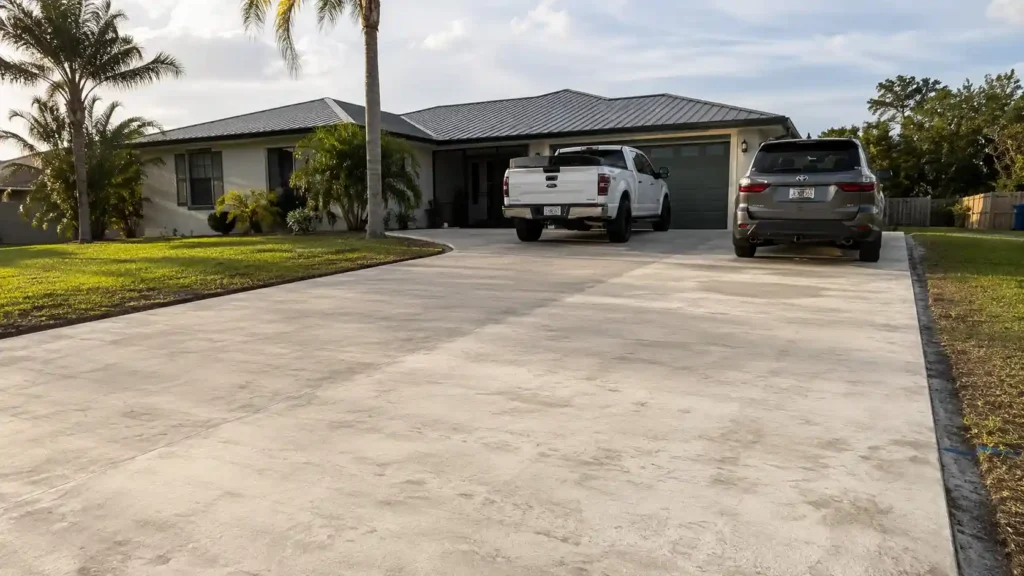
How thick should a concrete driveway be? At most homes, 4 inches is generally sufficient to support cars and light SUVs parked on driveways; 5 inches would suffice when parking trucks or larger SUVs. RVs, boat trailers or heavy equipment generally need thicker concrete layers over time for their longevity and resilience.
When asking how thick concrete should be on any given property driveway, consideration must also be made about vehicles being parked there and soil composition below them.
Why Driveway Thickness Matters More Than It Looks
An attractive driveway may appear simple from the outside, but its inner workings require serious engineering expertise to keep its surface flat for cars to drive across it safely and without cracks appearing over time. Driveway concrete thickness determines its lifespan as well as how many cracks appear over time and weight it can carry without crumbling under pressure.
Homeowners often ask how thick should a concrete driveway be only after cracks appear. By then, the damage is already done. Getting the number right before the pour saves money and stress for years to come.
| Vehicle Type | Recommended Thickness |
| Cars, light SUVs (standard driveway) | 4 inches |
| Trucks, larger SUVs, garage turning areas | 5 inches |
| RVs, boats/trailers, heavy equipment | 6 inches or more |
How a Concrete Slab Actually Carries Vehicle Weight
Concrete is strong when something presses against it, but weak when pulled apart – engineers refer to these forces as compression and tension respectively. A car’s weight pushes straight down on a slab and it handles that pressure well on its own; where problems lie is when the ground below isn’t completely even or firm.
When wheels roll over soft or uneven spots, concrete must flex slightly instead of sitting flat – this tension causes cracking; thicker slabs spread the load across more material which reduces tension significantly and maintains low tension levels to help avoid cracking altogether. That is why cement thickness for driveway projects shouldn’t just be chosen at random but depends on how resistant a particular slab is against being bent under weight.
What Happens When a Driveway is Poured Too Thin
Homeowners replacing an old driveway often ask how thick should concrete be for a driveway that’s already showing wear, and the answer is usually thicker than what’s there now. An inadequately thinned driveway might seem fine at first, until hairline cracks appear around its perimeter or garage entrance and then widen over time, chunks of concrete lift off, and it becomes uncomfortable underfoot.
Thin slabs also tend to settle more rapidly; water seeping into cracks saturates with soil underneath and creates voids which worsen with each passing year. Repairing driveways that were incorrectly laid-out often ends up costing more than having them laid properly from the start.
Standard Concrete Driveway Thickness by Vehicle Type
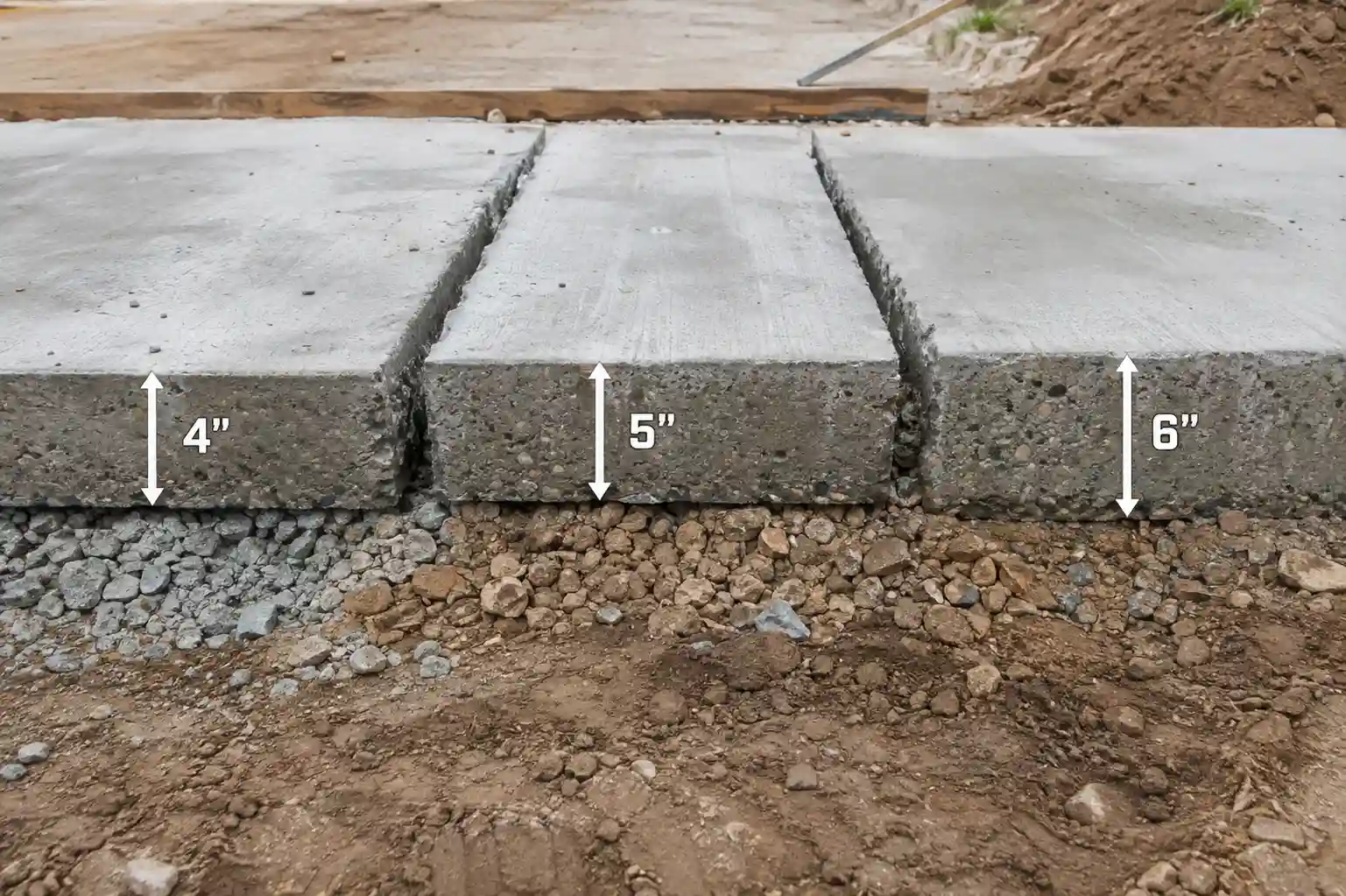
The honest answer to how thick concrete for driveway projects depends heavily on what’s going to be parked on it. Getting the cement thickness for driveway areas right means matching the slab to real-world use, not guessing. Here’s how that breaks down in practice.
4 Inches – Cars, Light SUVs, Standard Household Use
A 4 inch slab is the baseline for a typical residential driveway. If your household only parks passenger cars, crossovers, or light SUVs, 4 inches with the right base and mix design will hold up for decades. This is the most common thickness poured across Central Florida neighborhoods, and it works well when the concrete slab thickness matches the actual load it will see.
5 Inches – Trucks, Larger SUVs, Driveways Near the Garage With Frequent Turning
If your household has a full-size truck, a three-row SUV, or you’re often turning the wheel while stopped near the garage, 5 inches gives you a real margin. Turning tires while parked put extra twisting stress on the surface, and that stress adds up over thousands of trips. Homeowners replacing a cracked driveway that saw daily truck traffic usually find the original slab was poured too thin for the vehicles it carried.
6 inches (or more) – RVs, Boats/Trailers, Work Vehicles, Occasional Heavy Delivery Trucks
RV and boat trailer owners need to think about load-bearing capacity differently than a typical car owner. These vehicles concentrate a lot of weight on a small number of tires or trailer jacks. A 6 inch slab, sometimes reinforced further, is the safer choice if you regularly park an RV, boat trailer, work truck, or if delivery trucks back into your driveway on a regular basis.
Edges, Aprons, and Entry Points – Why These Areas Often Need Extra Thickness
The apron, which is the section of driveway closest to the street, takes more abuse than any other part of the slab. Vehicles turn sharply here, and city trucks or delivery vehicles sometimes drive partly onto it. Apron thickness is often increased beyond the rest of the driveway for this reason, and edge thickening along the perimeter helps prevent the corners from chipping or settling first, which is usually where damage starts.
What Else Affects the Right Thickness for Your Driveway
Thickness alone doesn’t tell the whole story. A few other factors change what a contractor should recommend for your specific property.
Subgrade and Soil Conditions in Central Florida
Most of Central Florida sits on sandy soil, which drains well and compacts predictably. That’s actually good news for driveway longevity. But fill dirt from past construction, or isolated pockets of clay-like soil, can behave differently. Subgrade conditions that aren’t properly assessed and compacted can undercut even a thick slab, because the concrete is only as stable as the ground supporting it. A contractor should check the soil before recommending a final thickness, not after.
Gravel Base Depth and Compaction
Underneath every properly built driveway is a compacted gravel base, usually 4 to 6 inches deep depending on soil conditions. This layer, called the subcase, improves drainage and gives the concrete a firm, even surface to rest on. Skipping proper subgrade compaction or using too shallow a gravel base depth is a common shortcut that leads to early cracking, even when the concrete itself is thick enough.
Local Permitting and Code Minimums
Orange and Seminole County both have building requirements that set minimum standards for residential concrete work. Florida Building Code minimums exist for a reason, and a licensed contractor should confirm current requirements with your local building department before pouring. This protects you if you sell the home later and need proof the driveway concrete thickness met code at the time of the pour.
Heat and Curing in Florida’s Climate
Homeowners in colder states worry about freeze-thaw cycles cracking their concrete. That’s generally not a major concern here, since Florida rarely sees the deep freezes that cause that damage. Instead, Florida’s heat creates its own challenge.
Curing time matters in high temperatures, because concrete that dries too fast on the surface while the core is still curing can develop surface cracks. A good contractor manages this with proper water curing, timing the pour around the hottest part of the day, and adjusting the PSI mix design for local weather.
Reinforcement: Does Rebar or Mesh Let You Pour Thinner Concrete?
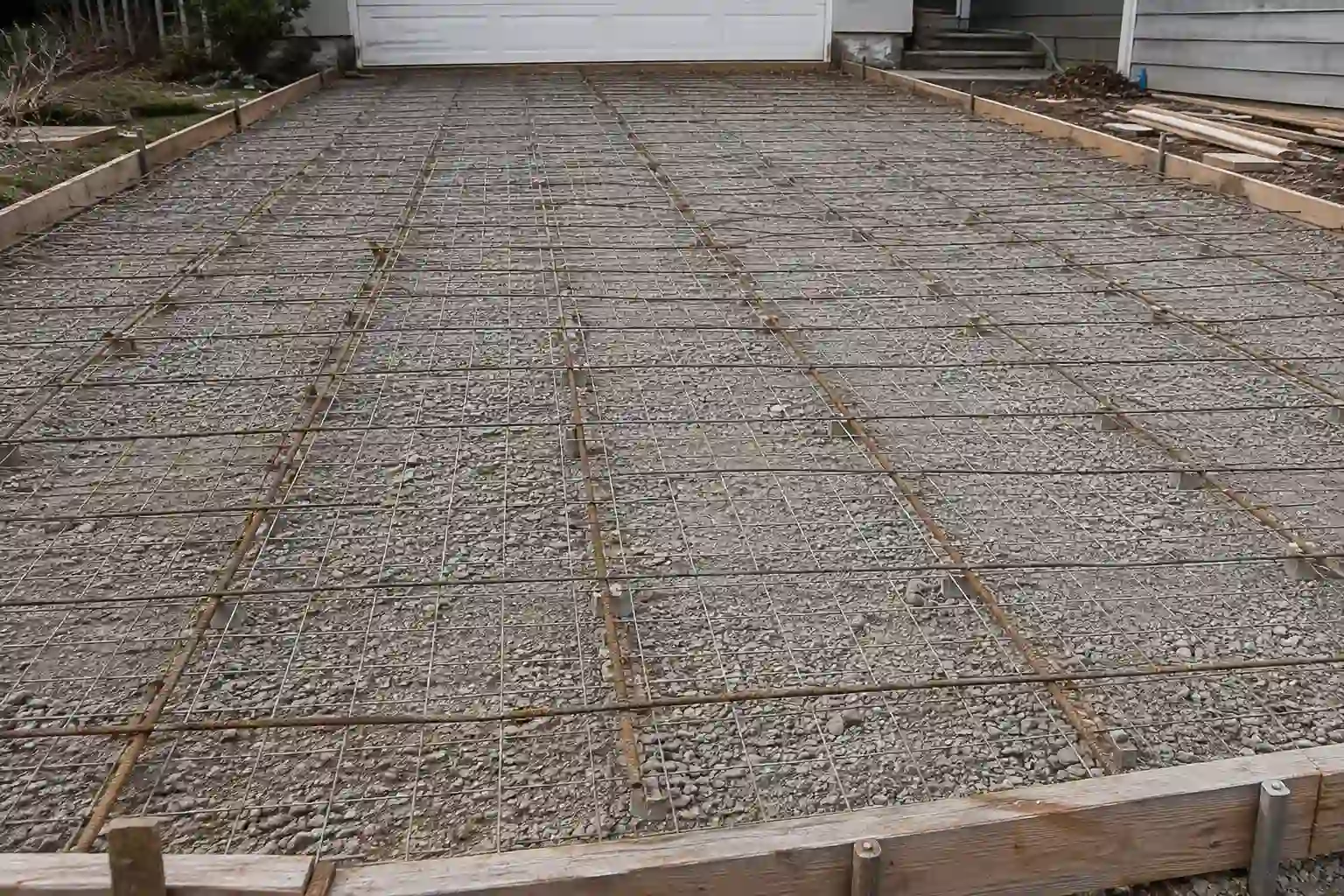
This is one of the most common questions homeowners ask, and it deserves a straight answer.
Fiber-Reinforced Concrete
Mixing small synthetic or steel fibers directly into the concrete helps control shrinkage cracking as the slab cures. Fiber-reinforced concrete is common on residential driveways today because it’s easy to work with and adds a layer of crack resistance without much added cost.
Welded Wire Mesh
Welded wire mesh sits inside the slab and helps hold cracks together if they do form, keeping the surface from separating and shifting. It needs to be positioned correctly during the pour, roughly in the middle of the slab, to actually do its job.
Rebar Grids For Heavy-Load Driveways
For driveways carrying RVs, boats, or heavy work vehicles, a grid of rebar (#3 or #4 bar is common) adds real structural strength. This is usually paired with a thicker pour, since rebar works best when it has enough concrete around it to bond properly.
The Honest Answer
Reinforcement controls cracking. It does not replace proper thickness. A thin slab with rebar in it can still fail under heavy weight, because the reinforcement can’t add load-bearing capacity that the concrete itself doesn’t have. Anyone telling you reinforcement lets you skip on proper driveway concrete thickness isn’t giving you the full picture.
New Driveway vs. Resurfacing an Existing One
Minimum Thickness When Pouring Over an Old Slab
Resurfacing, sometimes called an overlay, involves pouring a new layer over an existing driveway. This layer typically needs to be at least 2 inches thick to bond and perform correctly, and the old slab needs to be structurally sound underneath. Driveway resurfacing is a good option when the base is solid but the surface is worn, stained, or has minor surface cracking.
When Resurfacing Isn’t Enough
If the existing slab has deep structural cracks, sections that have settled unevenly, or damage from tree roots, resurfacing just hides the problem temporarily. In those cases, full removal and a new pour, built to the correct concrete slab thickness for your vehicles from the start, is the more reliable long-term choice.
Cost Considerations by Thickness
These may affect the cost consideration in concrete.
Estimating How Thickness Affects Material Volume
Once you know how thick should a concrete driveway be for your household, you can estimate the cost before calling a contractor. Concrete is priced by volume, measured in cubic yards. A driveway that’s 5 inches thick uses roughly 25 percent more concrete than the same driveway at 4 inches.
Multiply the square footage by the thickness in feet (4 inches is 0.33, 5 inches is 0.42, 6 inches is 0.5), then divide by 27 to get cubic yards. That’s how concrete driveway cost scales with thickness, and why how thick concrete for driveway decisions shouldn’t come down to price alone.
Why Cheaper Now Often Costs More Later
Pouring thinner to save money upfront can backfire. A slab that cracks early, settles, or needs to be replaced in ten years instead of thirty ends up costing more overall, not less. The extra material cost between a 4 inch and 5 inch driveway is usually small compared to the cost of tearing out and repairing a failed slab.
Questions to Ask Your Concrete Contractor Before You Sign
Before hiring any contractor, ask specific questions regarding base depth, PSI or mix strength, planned reinforcement type and spacing between control joints for control joints; whether edge thickening will be employed along the apron and perimeter; as well as what warranty backs their work. A contractor that answers these queries without hesitation or hesitation is an ideal partner in undertaking your job successfully.
Get an Accurate Driveway Thickness Recommendation for Your Home
Every driveway is different, and the right answer to how thick should a concrete driveway be depends on your vehicles, your soil, and how you actually use the space. Ron Hodges Inc offers free consultations for homeowners across Winter Springs, Oviedo, and Longwood, and every recommendation is based on your property, not a generic number pulled off a chart.
Reach out today to get a thickness and cost estimate built around your home.
FAQs
Is 4 inches enough for a concrete driveway?
For cars and light SUVs, yes. A 4 inch slab with proper subgrade compaction and a solid gravel base is the standard for most residential driveways in Florida.
Does rebar or wire mesh let me pour a thinner slab?
No. Reinforcement helps control cracking, but it doesn’t add the load-bearing capacity that comes from proper thickness. The two work together, not as a substitute for each other.
How thick should the gravel base be under a driveway?
Most driveways need a compacted gravel base between 4 and 6 inches deep, depending on the subgrade soil conditions on your property.
Can I pour new concrete over my old driveway, and how thick does it need to be?
Yes, if the old slab is structurally sound. An overlay usually needs at least 2 inches of new concrete to bond and hold up correctly.
How thick should the concrete apron be at the street?
Aprons typically need extra thickness beyond the main driveway, since they take more turning stress and occasional traffic from delivery or city vehicles.
Will a 4-5 inch driveway hold up to a moving truck or delivery truck backing in occasionally?
Occasional heavy trucks are usually fine on a 5 inch slab, especially with edge thickening at the entry point. Frequent heavy truck traffic calls for 6 inches.
Does Florida’s climate change how thick my driveway should be?
Florida’s heat affects curing time more than it affects the ideal thickness itself. Freeze-thaw damage generally isn’t a major concern here, but proper curing during hot weather still matters for how well the slab performs long term.