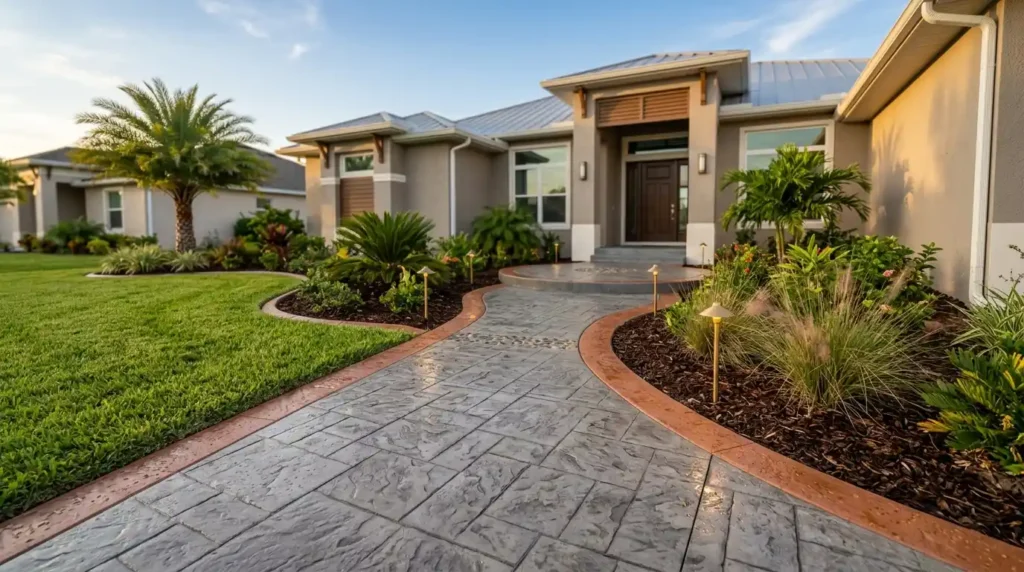
The best creative ideas for concrete paths are stamped patterns, stained color, exposed aggregate, gentle curves, and inlays like pebbles or tile. Each one turns a plain gray strip into a feature that fits your home. Most cost only a little more than a basic pour. Some add real grip underfoot, and some add color that lasts for years.
So what are some creative ideas for concrete paths that work in a Florida yard? This guide covers what each idea costs in effort, how it holds up in rain and sun, and which one fits your house and your budget.
Quick Answer: Best Creative Concrete Path Ideas
Here are ten concrete walkway ideas that homeowners ask about most:
- Stamped concrete: looks like brick, slate, or cobblestone.
- Stained or colored concrete: adds warm, rich color.
- Exposed aggregate: shows natural pebbles with a nonskid top.
- Curved or winding path: softens edges and follows garden beds.
- Grid or saw-cut patterns: scored squares for a clean look.
- Stepping stone slabs: big slabs with gravel or grass gaps.
- Pebble, tile or shell inlays: small mosaic accents.
- Bordered path: a stamped or colored band along the edges.
- Concrete with pavers or brick: concrete strips with paver inserts.
- Lit path with steps and landings: low lights and a round landing.
10 Creative Concrete Path Ideas
These are also the most popular decorative concrete walkway ideas we get asked about. Each one has a look, a best use, and one real catch.
Stamped Concrete (Brick, Slate, Cobblestone)
A stamped concrete walkway looks like brick, slate, or cobblestone, but it is one poured slab. Crews press stamp mats into wet concrete, then dust on color release so the pattern shows depth. It suits front entries where you want a stone look without paying for stone. The catch is timing. The stamping window is short, and the sealer needs a fresh coat every few years.
Stained or Colored Concrete
A stained concrete walkway gives you warm tan, rust, or soft gray tones. Integral color is mixed into the whole batch, so a chip does not show a gray core. Surface stain soaks into the top layer and can look richer, but strong sun can fade it. Both types need resealing, and surface stain shows every old patch underneath.
Exposed Aggregate
An exposed aggregate walkway shows the small pebbles inside the concrete. Crews wash off the thin top layer soon after the pour, which reveals the stones. The rough, nonskid surface gives good grip, so it works well near pools. The catch is comfort. It feels bumpy on bare feet, and leaves and dirt settle in the texture.
Curved or Winding Path
A curved concrete walkway follows your garden beds and gives the yard soft edges. Crews bend flexible forms to set the curve before the pour. Among all concrete garden path ideas, this one fits yards with trees, pool edges, or side gardens best. The catch is cost. Curves take more formwork and more time than a straight run.
Grid or Saw-Cut Patterns
Scored squares give plain or colored concrete a clean, modern look. Crews cut control joints on a grid, often in 3 ft by 3 ft panels. Those cuts also guide cracks to the lines, where they hide. The catch is timing again. Cut too late and the slab cracks first, and cut too shallow and the joint does nothing. A good rule is about one quarter of the slab depth.
Large Slab “Stepping Stone” Look With Gravel or Grass Gaps
Big square slabs with gravel or grass between them make a modern concrete walkway. Staggered slabs with dark gravel in the gaps add strong contrast. This look suits clean-lined homes and low-water yards. The catch is the steel and base. Rebar does not run across the gaps, so each slab needs its own steel and a well-packed base, or it will rock.
Pebble, Tile or Shell Inlays
Embedded stones, terra-cotta tile, or shell pieces add small mosaic accents. Many homeowners place one near the front door or at a path bend. Crews press the pieces into wet concrete or set them in a cut recess. The catch is grip and hold. Glazed tile gets slick when wet, and loose pieces can pop out if they are set too late.
Bordered Path (Stamped or Colored Band)
A band along each edge frames the path and makes a plain center look planned. Use a stamped band, a colored band, or a paver border in a contrast shade. It works well on long walks from the street to the door. The catch is color matching. A band that is too close to the center looks like a mistake, and one that is too far looks heavy.
Concrete Mixed With Pavers or Brick
A concrete paver walkway can use concrete strips with paver or brick inserts. The concrete carries the load, and the pavers add color and pattern. It suits people who like pavers but want fewer loose joints and a lower price than an all-paver path. The catch is the seams. Edges must be clean, and the pavers can settle over time.
Lit Path With Steps and Landings
Low path lights or built-in riser lighting make a walk safe at night. A curved step or a round landing circle also breaks up a long run. This idea suits sloped yards, front steps, and paths to a pool deck. The catch is planning. Wire and conduit must go in before the pour, or you will cut into finished concrete later.
How to Choose the Right Idea
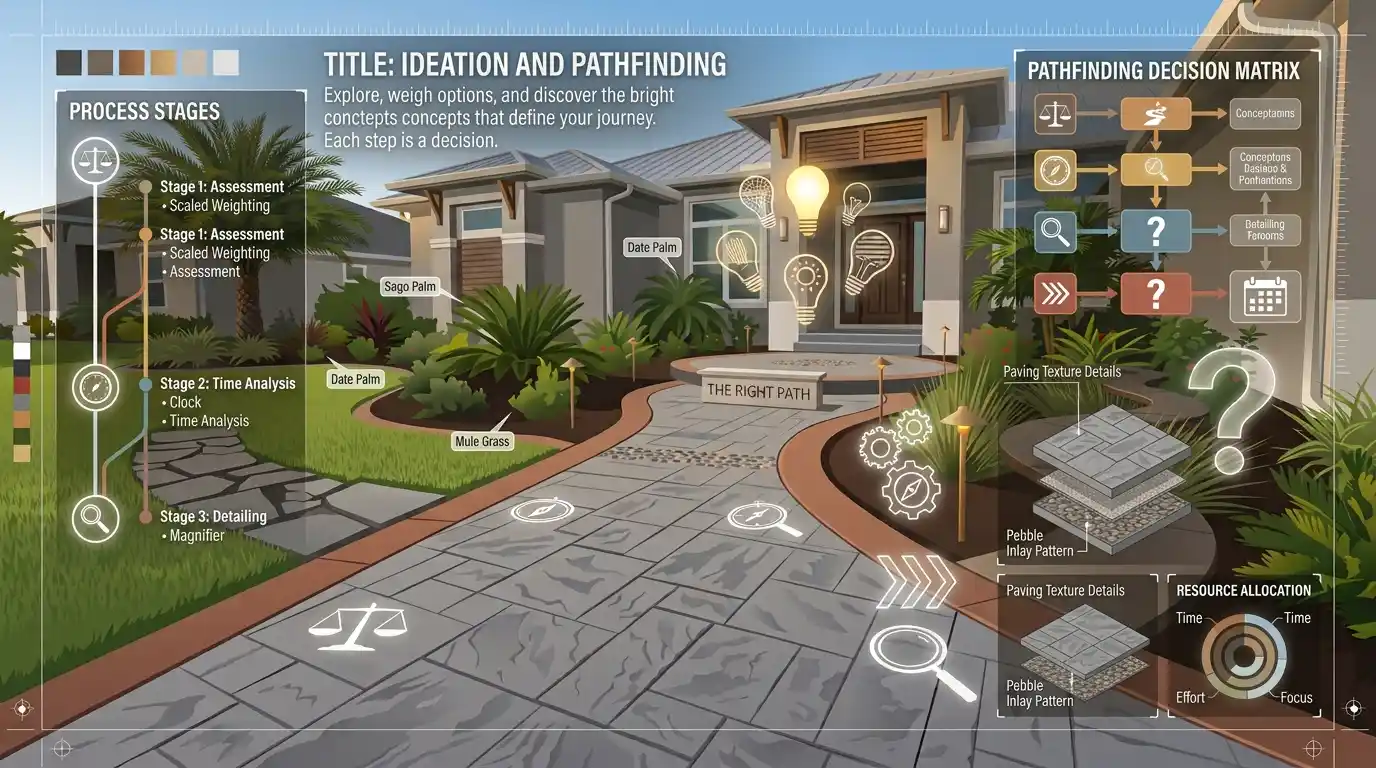
If you are still asking what are some creative ideas for concrete paths that fit your budget, start with three things. Pick your slip grip first, then your upkeep level, then your look. A good concrete walkway design starts with how the path is used, not with a photo.
For a tight budget, scored squares and a simple border cost the least. For house style, a stamped pattern suits a traditional home, while stepping stone slabs suit a modern one. For yard shape, a straight path fits a narrow side yard, and a curve fits a wide front lawn. If cost is your main worry, read our guide on What Is the Cheapest Type of Walkway first.
| Idea | Look | Upkeep | Slip grip | Effort |
| Stamped | Brick, slate, stone | Reseal every few years | Fair | Medium |
| Stained or colored | Rich solid color | Reseal, stain may fade | Fair | Low to medium |
| Exposed aggregate | Natural pebbles | Low, wash it | High | Medium |
| Curved | Soft and flowing | Same as the finish | Same as the finish | Medium to high |
| Grid or saw-cut | Clean squares | Low | Good | Low |
| Stepping stone slabs | Modern and bold | Weeds in gaps | Good | Medium |
| Inlays | Detailed accents | Check loose pieces | Varies | High |
| Bordered | Framed and planned | Same as the band | Same as the finish | Medium |
| Concrete with pavers | Mixed texture | Level pavers, refill joints | Good | Medium to high |
| Lit with steps | Safe and inviting | Check bulbs | Depends on finish | Medium to high |
Keep this in mind: a broom finish adds grip to almost any of these looks. If kids, older adults, or a pool are part of the picture, grip should win over style.
What Holds Up in Central Florida
Rain and humidity test every path here. Shaded paths stay damp longer, so algae grows there first. A green film on a smooth stamped or stained surface turns slick fast. A rougher finish, like exposed aggregate or a broom texture, is safer in those spots.
Sun is the other problem. Strong light fades surface stain and thin sealer over time. Integral color holds better because the color runs through the slab. Sealer helps with both stains and wear, but it can also make a surface smoother when wet. Ask for a grip additive in the sealer on any path near a pool deck or a downspout.
Pool deck paths need the most care. Wet feet, sun, and chlorine splash all meet in one spot. Exposed aggregate, rock salt finish, and broom finish all work well there. Glossy sealer and glazed tile do not.
How Much Do Creative Concrete Paths Cost?
Local prices change with access, slope, base work, and design. National figures give you a fair starting point.
| Option | National range per sq ft | Source |
| Plain poured concrete | $6 to $12 | Lawn Love |
| Stained (added to the pour) | Add $2 to $4 | LawnStarter |
| Stamped concrete | $8 to $28 | LawnStarter |
| Concrete pavers | $9 to $20 | LawnStarter |
| Sealer | About $1.50 | Lawn Love |
Here is a simple example. A path 40 feet long and 4 feet wide is 160 square feet. Plain concrete would land near $960 to $1,920. Stamped would land near $1,280 to $4,480. Adding stain would add roughly $320 to $640. Stamped has the widest range because pattern, color, and edge work change the labor.
Removing old concrete adds about 30 to 50 cents per square foot, according to LawnStarter. Slopes, curves, and tight access add more. We price each job after we see the yard, so numbers on paper never replace a visit.
Can You Upgrade an Existing Concrete Path?
Often, yes. A stamped overlay is a thin layer of polymer cement pressed with a pattern over sound old concrete. Staining adds color without a new pour. Resurfacing smooths a rough or flaking top.
Cracks come first. Fill and repair them before any new surface goes on, or they show through again. If the slab has sunk or heaved, a new pour is the better move. We cover that choice in Can You Pour New Concrete Over Old Concrete.
DIY or Hire a Pro?
A plain, straight path is a fair DIY job if you have help. A creative path is harder. You need tight forms, a compacted base, and a plan for curing. Finishing timing matters most. Stamping, for example, must happen while the surface is soft enough to take the mat and firm enough to hold it. Miss that window and you cannot redo it.
Digging comes first, and it decides how long the path lasts. For stamped, stained, curved, or inlay work, most homeowners do better with a pro. Ron Hodges Inc has poured and finished walkways in this area for more than 30 years. Our Concrete Walkways in Winter Springs FL shows what we offer.
Final Thoughts
Every idea here can work, but the best fit depends on grip, upkeep, and your yard. Stamped and stained add look, exposed aggregate adds safety, and curves and borders add shape. Pick the finish that handles Florida rain first, then add style on top. That is the real answer to what are some creative ideas for concrete paths: choose one that looks good and stays safe.
Ready to build one? Ron Hodges Inc pours creative concrete walkways in Winter Springs, Oviedo, and Longwood, FL. Contact us today for a free quote. We will visit your yard, talk through your ideas, and give you a clear price.
FAQs
What is the cheapest way to decorate a concrete path?
A simple broom finish with saw-cut square patterns is an affordable way to give a concrete path more character. Adding a colored border can make it stand out without the extra cost of full stamped concrete.
Is stamped or stained concrete better for a walkway?
Stamped concrete creates the look of stone or brick, while stained concrete adds color without changing the surface texture much. If the walkway gets wet, consider a broom-finished surface for traction or choose a textured finish designed for safe foot traffic.
Are exposed aggregate paths slippery?
Exposed aggregate usually provides a textured surface that can offer good traction underfoot. However, the level of grip depends on the aggregate, finish, slope, and sealer used. A glossy sealer may make the surface more slippery when wet, so ask your contractor about suitable non-slip options.
Can you add color to an existing concrete walkway?
Yes, you can often refresh an existing concrete walkway with a compatible concrete stain, dye, or overlay. The surface should be in good condition, and cracks or other damage should be addressed first. Keep in mind that the final color can vary depending on the concrete’s age, condition, and previous treatments.
How wide should a concrete path be?
A typical residential concrete path is about 3 to 4 feet wide. A 4-foot path offers more room for two people to walk comfortably or for carrying groceries. Accessible routes may have specific width requirements, so check the applicable standards and local codes if accessibility is a concern.
Do curved concrete paths cost more?
Curved concrete paths often cost more than straight ones because they require additional formwork, layout, and labor. A gentle curve may add only a modest amount, while a path with several tight bends can take considerably more work. The final cost depends on the design, site conditions, and installation requirements.