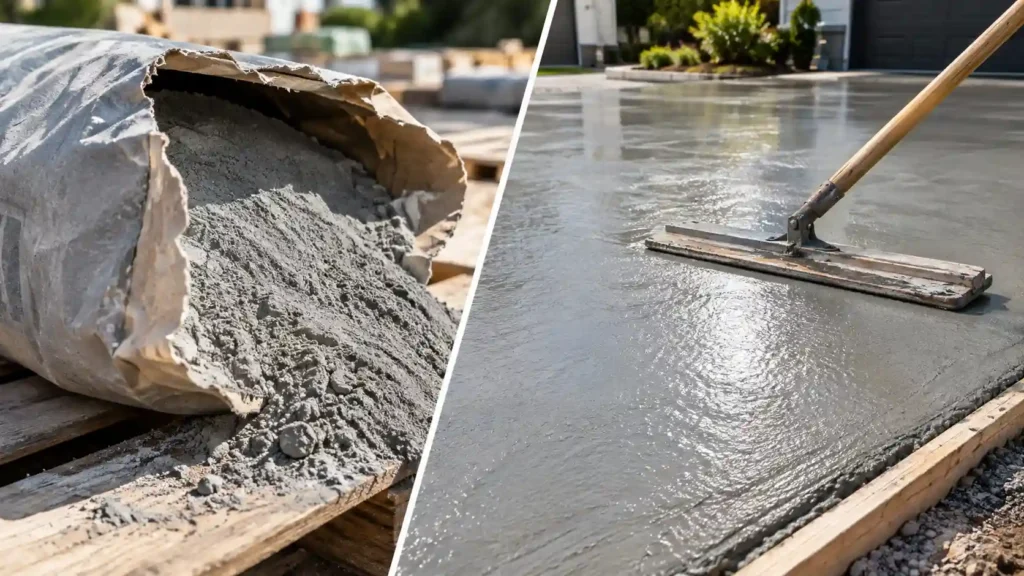
Is concrete the same as cement? No, it isn’t. Cement is a powder ingredient. Concrete is the finished building material cement helps create, along with water, sand, and crushed stone. Once you understand that one relationship, most of the confusion clears up fast.
People use these two words like they mean the same thing every day. If you’re planning a driveway or patio pour, though, knowing the real difference matters for your project and your budget.
What Is Cement?
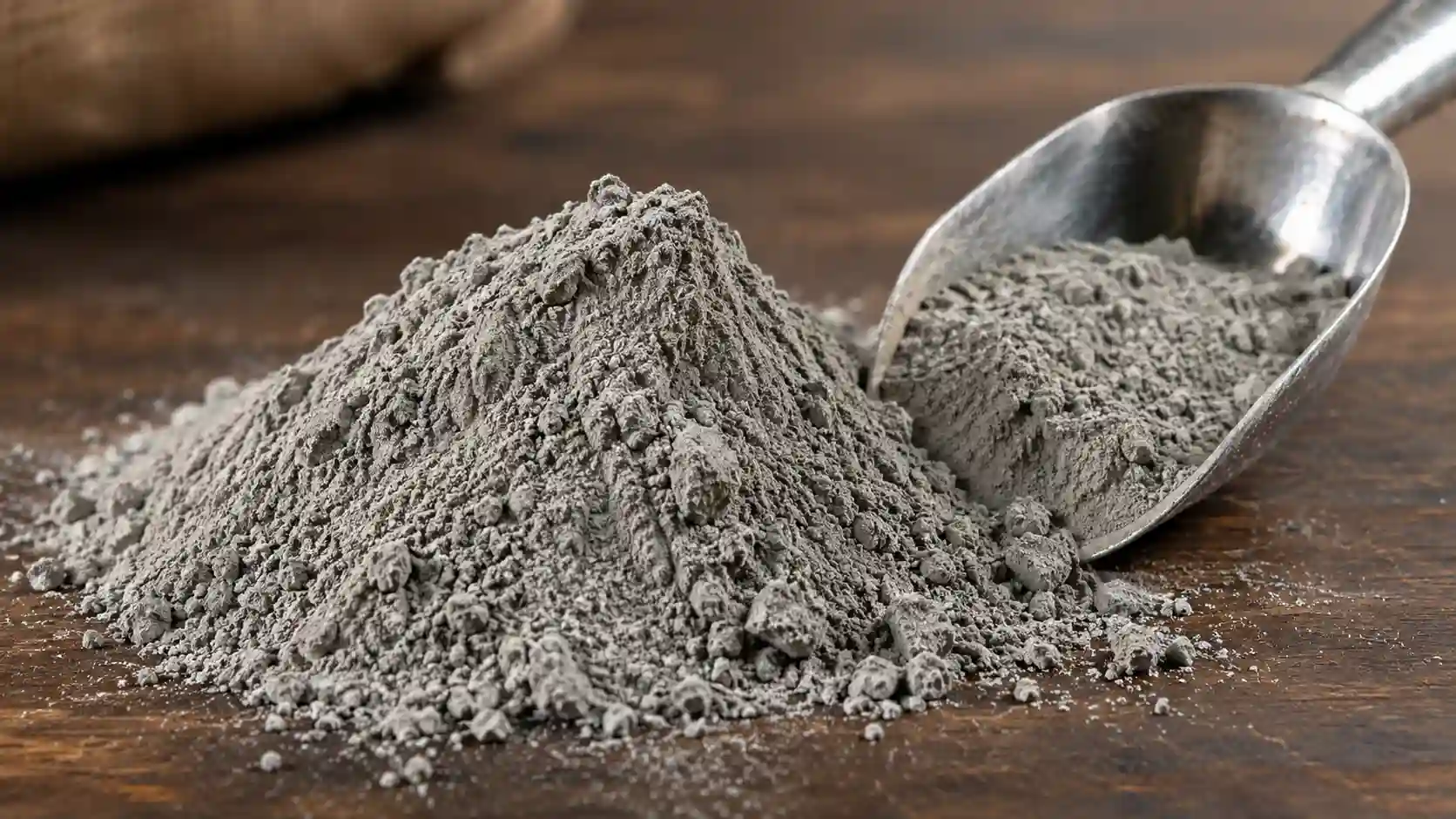
Cement is a fine gray powder made to bind other materials together.
Manufacturers make it by heating limestone and clay in a giant kiln, at temperatures near 2,700°F. That process, called calcination, breaks the raw rock down and forms a rock-like substance called clinker. Workers then grind the clinker into the fine powder you know as cement.
The most common type used in the U.S. is Portland cement. On its own, cement isn’t very strong. Mixed with water, it forms a thick paste. That paste is what glues everything else together once it hardens. Cement never gets poured by itself on a job site. It’s always the first step, never the final product.
What Is Concrete?
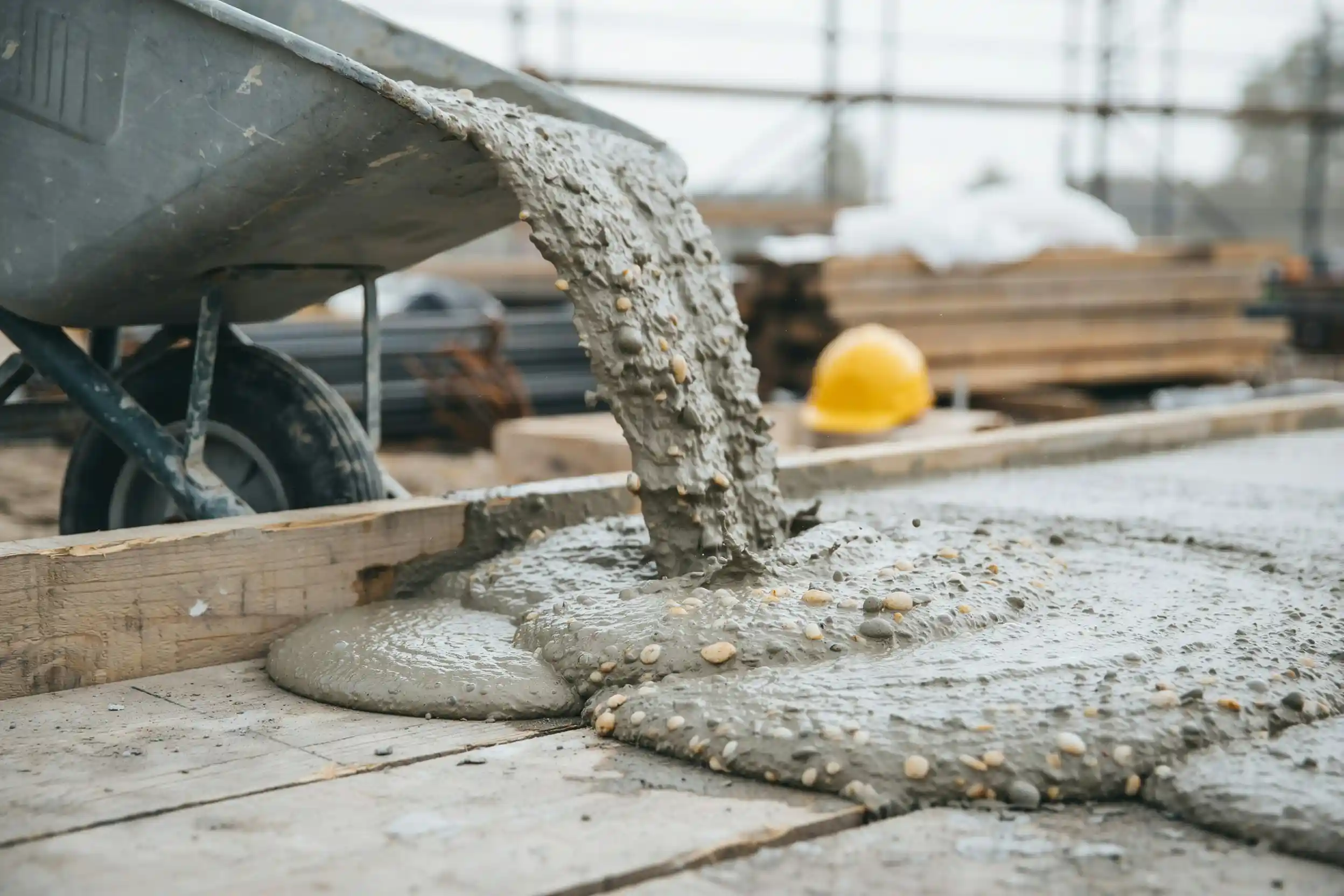
Concrete is the hard, gray building material you see in driveways, sidewalks, and foundations.
It’s made by combining cement with water, sand, gravel, and crushed stone. Those sand and stone materials are called aggregate, and they make up most of the mix, usually 60 to 75 percent by volume. Cement in concrete only accounts for about 10 to 15 percent.
Add water to cement and a chemical reaction called hydration begins. It forms a compound called calcium silicate hydrate, which is what actually hardens and locks the aggregate into one solid mass. That’s why concrete keeps getting stronger for weeks, not just hours. It’s still curing long after the surface looks dry.
Cement vs. Concrete at a Glance
Here’s a quick side-by-side, since a table answers this faster than a paragraph can.
| Factor | Cement | Concrete |
| What it is | A fine powder binder | A finished building material |
| Made from | Limestone, clay, heat | Cement, water, sand, gravel |
| Compressive strength | Weak on its own | 2,500 to 4,500+ psi, depending on the mix |
| Cure time | Sets in hours as a paste | Sets in 24 to 48 hours, fully cures around 28 days |
| Typical cost | $10 to $20 per 60 to 94-lb bag | $110 to $165 per cubic yard delivered, national average |
| Common uses | Mortar, grout, small patches | Driveways, patios, walkways, foundations, sidewalks |
Your actual price depends on your region, mix strength, and delivery distance.
Why Everyone Mixes Up “Cement” and “Concrete”
People say “pour the cement” so often it starts to sound correct. It isn’t. You can’t pour cement by itself. It’s a dry powder until you add water, and even then it needs sand and aggregate before it’s something you’d build with.
The mix-up probably started because cement is the ingredient people recognize by name. Bags at the hardware store are labeled “cement” or “concrete mix,” and the packaging doesn’t always spell out the difference. Even the term “cement mixer” adds to it, since that machine actually mixes concrete, not plain cement.
Throw mortar into the mix, made from cement, sand, and lime with no coarse aggregate, and it’s easy to see why people ask if concrete is the same as cement in the first place. Mortar bonds bricks and stone. It was never built to carry the weight a driveway slab has to handle.
What Concrete Is Made Of
If you’re wondering what concrete is made of, the short answer is four ingredients: cement, water, sand, and coarse aggregate like gravel or crushed stone.
A standard mix ratio runs roughly 1 part cement to 2 parts sand to 3 parts aggregate, sometimes called the 4-2-1 rule once water is factored in. The water-cement ratio matters more than most people expect. Too much water weakens the finished slab. Too little makes it hard to pour and finish evenly. Most residential mixes aim for a ratio around 0.45 to 0.5.
Contractors also use admixtures to change how a mix behaves on site. Some speed up curing in cold weather. Others slow it down in Florida heat, giving crews enough time to level and finish the surface before it starts to set.
Ready-mix concrete, delivered by truck already blended, is what most driveway and patio jobs use. Bagged concrete mix, the kind sold at hardware stores, works fine for small pours like fence posts or steps, but it isn’t practical for a full driveway.
Concrete Driveway Materials: What Actually Goes Into a Slab
A driveway needs more than a basic mix. It has to hold up under the weight of vehicles for decades, not just months.
Most residential driveways use concrete rated between 3,000 and 4,000 psi, based on ready-mix industry guidelines from the Indiana Ready Mixed Concrete Association. Go lower than that and you’re risking cracks sooner under regular car and truck traffic. Standard slab thickness for a passenger driveway runs about 4 inches, poured over a properly compacted base.
Reinforcement matters too. Rebar or wire mesh embedded in the slab helps control cracking as the concrete shrinks slightly while it cures. Control joints, cut into the surface at set intervals, give cracks a planned place to happen instead of splitting randomly across your new driveway.
Here’s a real number to work with. A 20 by 24-foot driveway poured at 4 inches thick needs close to 6 cubic yards of concrete. At a national average of about $125 per cubic yard, material alone runs around $750, before labor, forms, rebar, and finishing are added in. Want the full breakdown by vehicle type and climate? Our guide on How Thick Should a Concrete Driveway Be covers exact recommendations.
Cement or Concrete: Which One Do You Actually Need?
For most home projects, the answer is concrete, not cement alone.
If you’re patching a small crack, filling a fence post hole, or fixing a chipped step, a bagged cement-based patch product works fine. Those jobs don’t carry real weight.
If you’re pouring a driveway, patio, walkway, or foundation, you need full concrete: cement, sand, aggregate, and water, mixed and placed correctly. Cement by itself can’t handle the weight or daily wear those surfaces take on.
Get It Poured Right the First Time
Knowing the difference between cement and concrete helps you talk to a contractor with confidence. Getting a slab poured at the right thickness, psi, and finish still takes real hands-on experience.
Ron Hodges Inc has been pouring driveways, patios, and walkways across Winter Springs, Oviedo, and Longwood, FL, and we know how Central Florida heat and rain affect a fresh pour. If you’re planning a new patio, take a look at our Concrete Patio in Winter Springs FL work to see what a properly finished slab looks like.
Ready to discuss your concrete project? Contact us to learn more about our concrete and paver services.
FAQs
Can you buy cement by itself and use it alone?
Yes, you can buy bags of plain cement. It’s rarely used alone, since it doesn’t have the strength or bulk to hold up on its own. Most homeowners actually want a bagged concrete mix, which already includes sand and aggregate.
Is mortar the same as cement?
No. Mortar contains cement, sand, and lime, but no coarse aggregate. It’s built to bond bricks and stone together, not to carry structural weight the way concrete does.
Does concrete dry harder than cement?
Concrete ends up far harder and stronger than cement paste alone. Cement paste is just the binder. Concrete gets its real strength from the sand and aggregate locked inside that hardened paste.
How long does concrete take to cure in Florida’s heat and humidity?
Concrete typically reaches most of its strength in about 28 days. Florida’s heat can speed up the surface set while humidity slows the curing happening underneath. Crews often adjust the mix and timing to keep the slab from setting unevenly.